


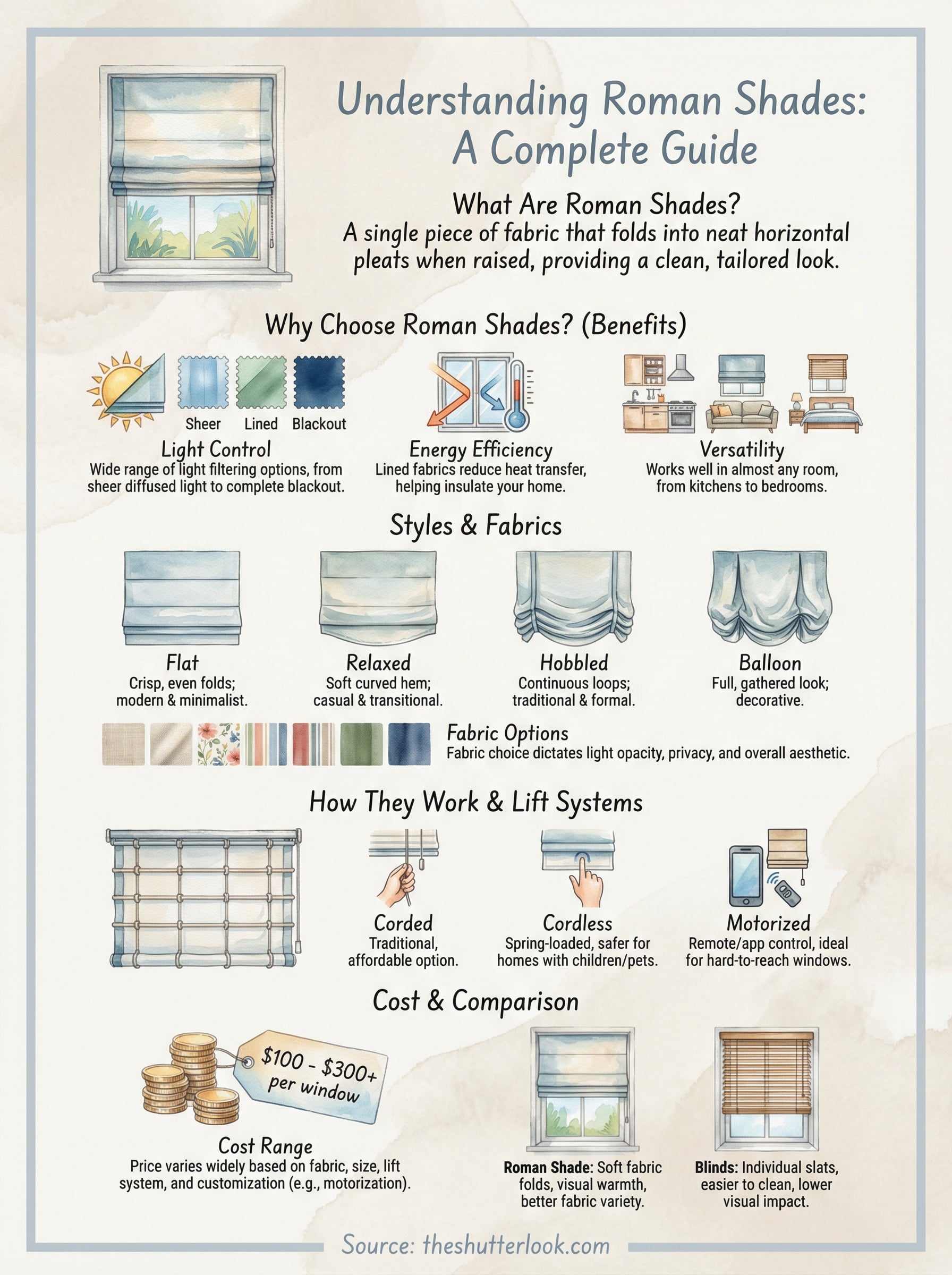
If you’ve been shopping for window treatments, you’ve probably asked yourself what are Roman shades, and why so many homeowners seem to love them. Unlike standard blinds that use individual slats, Roman shades are made from a single piece of fabric that folds into neat, horizontal pleats when raised. They sit flat against the window when lowered, giving your room a clean, tailored look that works in just about any space.
Roman shades have been around for centuries, but the options available today go far beyond the basics. Between flat-fold, hobbled, balloon, and relaxed styles, plus a wide range of fabrics, opacities, and lift systems, there’s a lot to sort through. Each style affects how the shade looks, how much light it filters, and how well it insulates your windows. Choosing the right one comes down to your room’s function, your aesthetic preferences, and your budget.
At The Shutter Look, we’ve spent over 23 years helping Central Florida homeowners find the right window treatments for their homes. We’ve installed thousands of shades, shutters, and blinds, and Roman shades remain one of the most requested options we carry. This article breaks down exactly how Roman shades work, the styles you’ll come across, what they cost, and how they compare to other window treatments, so you can make a confident decision before your next project.
Why roman shades are a go-to window treatment
Roman shades have stayed popular for a reason: they deliver practical function and visual appeal in one package. When most homeowners ask what are Roman shades really good for, the answer usually comes back to light management and aesthetics. Unlike bulky curtains that stack up on each side of the window, Roman shades fold cleanly upward, keeping your window area tidy whether the shade is open or closed.
They give you real light control
The fabric you choose determines how much light filters through your shade, and Roman shades give you a wide spectrum to work with. Sheer fabrics let in soft, diffused daylight while still providing some privacy during the day. Lined or blackout fabrics block sunlight completely, making them a solid choice for bedrooms, media rooms, or any space where you need full darkness. In Central Florida, where sun exposure is intense year-round, the ability to dial in exactly how much light enters your room is a practical advantage.
The right opacity level can also reduce heat gain through your windows, which directly impacts how hard your air conditioning works during summer months.
You can also layer Roman shades with sheer panels or shutters if you want additional control or a more layered look. This flexibility makes them one of the more versatile window treatment options available, regardless of your room’s layout or function.
They work in almost any room
Roman shades fit naturally in kitchens, living rooms, bedrooms, and offices because their clean lines do not compete with your existing decor. A flat Roman shade in a neutral linen fabric reads as minimal and modern. A hobbled or balloon style in a patterned fabric adds softness and texture to a more traditional space. The wide range of available fabrics and styles means you can match the shade to the room rather than redesigning the room around the shade.
They also work well on standard windows, arched frames, and sliding doors when configured correctly. This adaptability is one of the main reasons homeowners who start with one Roman shade often end up adding them to multiple rooms over time.
How to choose a roman shade style and fabric
Once you understand what are Roman shades and how many options exist, the next step is narrowing down which style and fabric actually fit your space. Two decisions drive every Roman shade purchase: the fold style, which shapes how the shade looks when raised or lowered, and the fabric, which controls how much light and privacy you get. Getting both right makes the shade feel like it belongs in the room rather than like a last-minute addition.
Match the style to your room’s look
Your room’s existing decor and how formally you’ve styled it are the best starting points. Each fold style behaves differently when raised and lowered, so the right choice depends on your aesthetic preferences and how frequently you’ll operate the shade day to day.
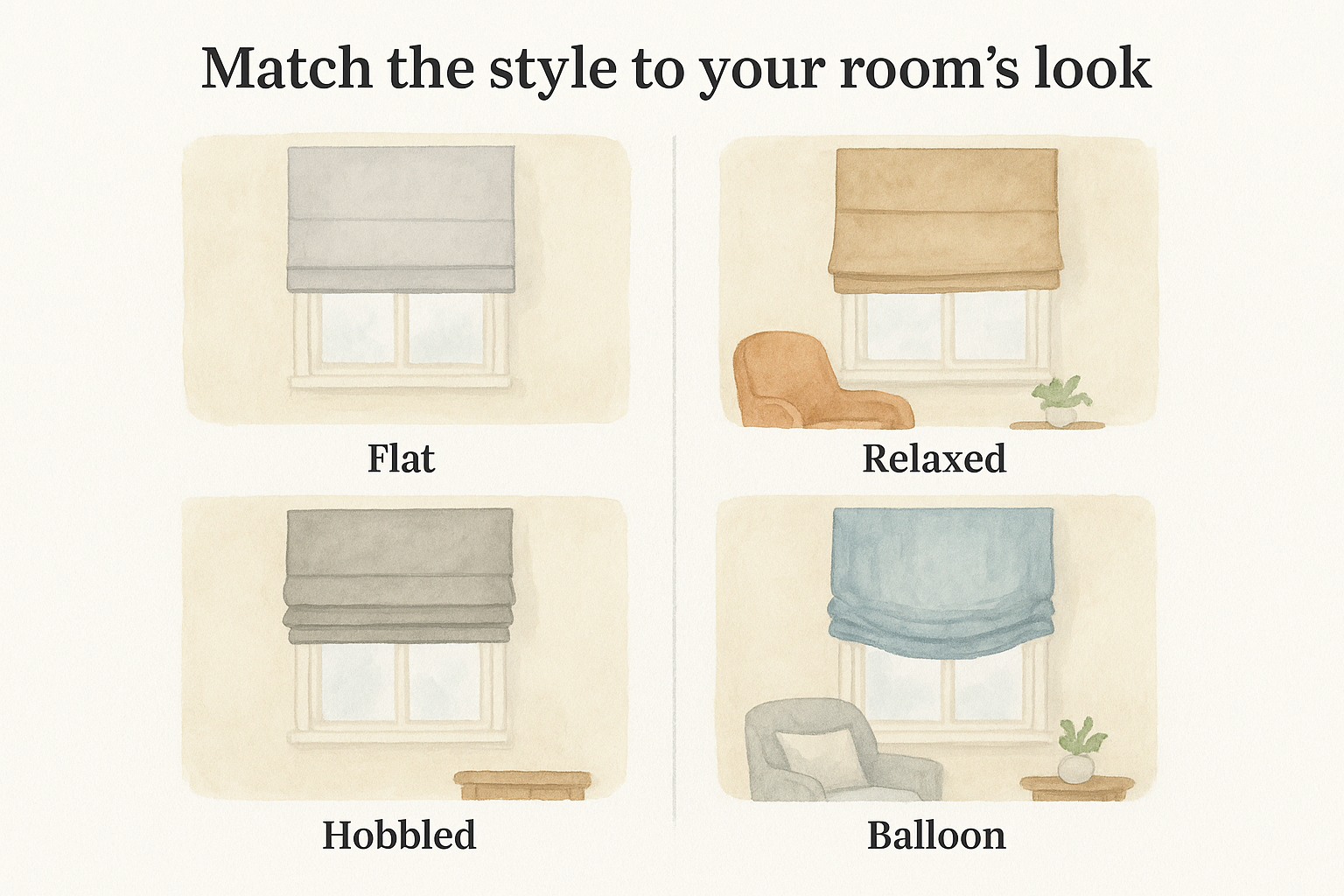
- Flat: Crisp, even folds; best for modern and minimalist spaces
- Relaxed: Soft curved hem; suits casual or transitional rooms
- Hobbled: Continuous loops of fabric; works well in traditional or formal settings
- Balloon: Full, gathered look; primarily decorative
Pick your fabric based on function
Fabric opacity is the most practical decision you’ll make. Sheer and light-filtering fabrics let daylight in while softening harsh glare, making them a natural fit for living rooms and kitchens. Blackout or lined fabrics block sunlight entirely and work best in bedrooms and media rooms.
In Central Florida, a lined fabric also helps reduce heat transfer through the glass, which adds up quickly over a long, sunny season. If you want a middle ground, a light-filtering fabric with a privacy lining gives you daytime privacy without sacrificing all the natural light.
Choosing a lined fabric for any sun-facing window can noticeably reduce heat buildup near the glass during peak afternoon hours, which takes pressure off your air conditioning.
How roman shades work
Understanding what are Roman shades mechanically helps you choose the right lift system and maintain them over time. At the core, every Roman shade works the same way: a series of horizontal rings sewn into the back of the fabric align with vertical cords that run up through the shade and connect to a lift mechanism at the top. When you pull the cord or activate the lift, the cords shorten, pulling the fabric upward in even horizontal folds.
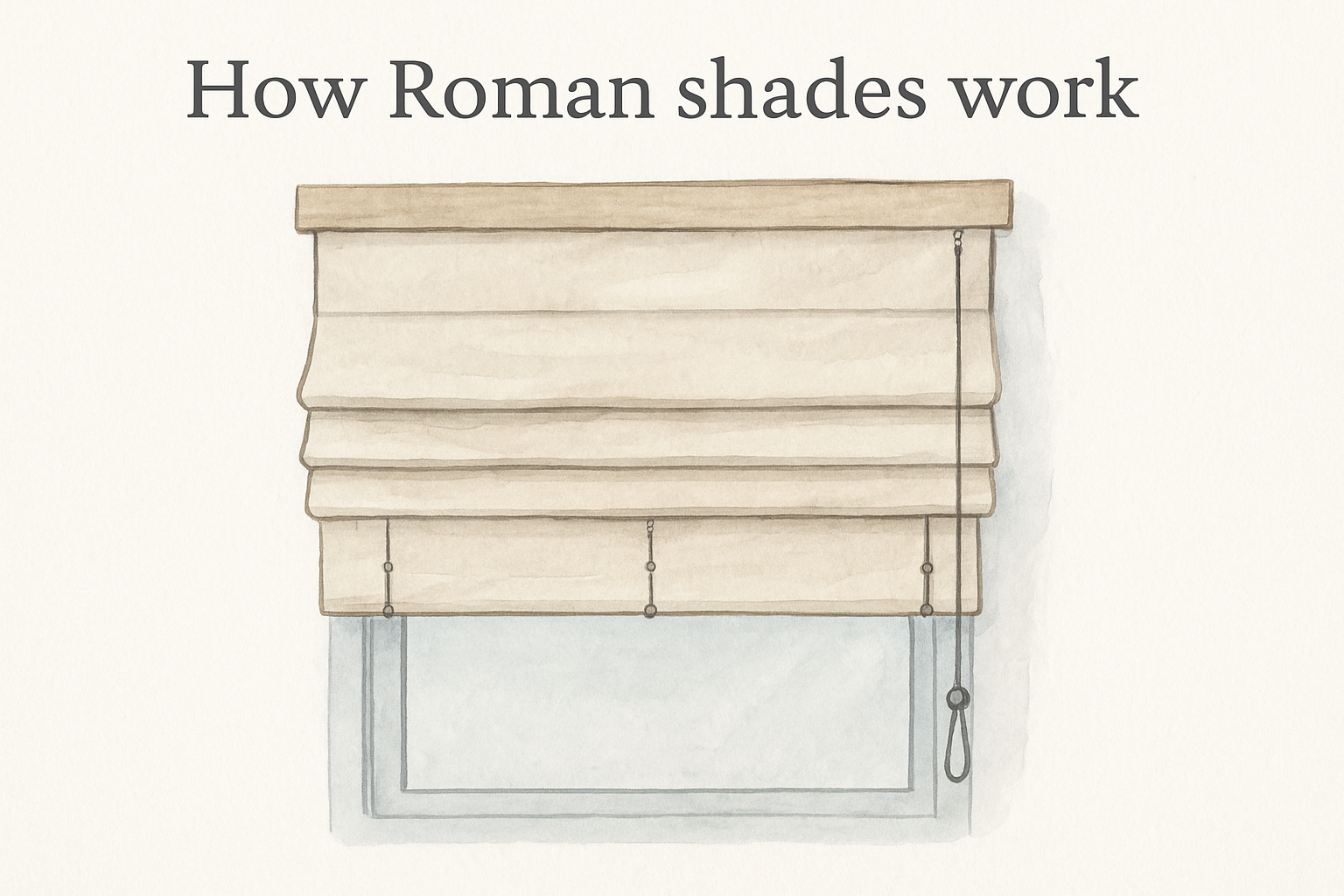
A properly installed Roman shade should stack cleanly at the top of the window without bunching on one side, which depends entirely on accurate measurement and ring alignment during installation.
The lift system options
Your lift system determines how you operate the shade day to day. Corded systems use a traditional pull cord on one side and remain the most affordable option. Cordless systems use a spring-loaded mechanism that lets you push the shade up or pull it down directly, which removes exposed cords from the window and is a safer choice in homes with children or pets. Motorized systems connect to a battery or hardwired motor, letting you raise or lower the shade with a remote or a smart home app.
How the fabric folds
The rings sewn into the back of the shade are spaced at consistent intervals, typically every six to eight inches, depending on the shade’s total length. Each row of rings lines up vertically so the cords pull the fabric evenly across the full width of the window. When the shade is fully lowered, the fabric lies flat against the glass. When raised, it stacks into the layered horizontal folds that give Roman shades their signature look.
What roman shades cost and what affects price
When people wonder what are Roman shades worth investing in, the honest answer is that price varies widely depending on fabric, size, and lift system. A basic corded Roman shade in a standard window size can run as low as $50 to $150, while a fully lined, motorized shade in a premium fabric can push past $400 per window. Knowing what drives those differences helps you set a realistic budget before you start shopping.
The price range you can expect
Most homeowners spend between $100 and $300 per window for a quality Roman shade that includes professional installation. Custom shades cut to your exact window dimensions sit at the higher end of that range, while ready-made retail options land at the lower end. Keep in mind that off-the-shelf shades rarely fit windows perfectly and may need additional hardware or adjustments to operate correctly.
Professional installation adds cost upfront, but a correctly mounted shade operates smoothly and lasts significantly longer than one hung without precise measurements.
What drives the price up or down
Fabric choice is the single biggest price variable. Sheer and basic cotton fabrics cost less than specialty textiles, outdoor-rated materials, or patterned prints that require pattern matching during fabrication. Motorization typically adds $100 to $200 or more per shade depending on the system, but it makes practical sense for hard-to-reach windows or homes set up for smart home control. Window size, lining type, and whether you need fully custom fabrication all factor into your final number as well.
Roman shades vs blinds and other window treatments
When you understand what are Roman shades and how they function, it becomes easier to see how they stack up against other options like blinds, curtains, and shutters. Each window treatment handles light, privacy, and aesthetics differently, and the right choice depends on what you actually need the window to do in that room.
How roman shades compare to blinds
Roman shades and blinds both mount inside or outside your window frame and offer adjustable light control, but they work in completely different ways. Blinds use individual horizontal or vertical slats that tilt to redirect light or stack when raised. Roman shades use a single continuous piece of fabric that folds upward, which gives them a softer, more finished appearance. Blinds typically cost less and are easier to clean, while Roman shades bring more visual warmth and better fabric variety to the window.
If you want a window treatment that doubles as a design element rather than just a functional cover, Roman shades consistently deliver more visual impact than standard blinds.
How roman shades compare to curtains and shutters
Curtains offer similar softness to Roman shades but take up more space when open, framing the sides of the window rather than stacking neatly at the top. Roman shades keep the window view unobstructed when fully raised, which matters in rooms where natural light is a priority. Shutters provide the most durable and light-precise option of the three, but they come at a higher price point. Roman shades sit comfortably between curtains and shutters on both cost and functionality, making them a practical middle ground for most rooms.
Picking roman shades with confidence
Now that you know what are roman shades, how they work, and what they cost, you have everything you need to make a confident buying decision. The right shade comes down to the style that matches your room’s aesthetic, the fabric opacity that fits your light and privacy needs, and the lift system that suits how you use the window day to day. Get those three things right, and your shade will look good and perform well for years.
Window measurements and installation quality matter just as much as the product itself. A shade cut to the wrong dimensions or mounted without precise alignment will never operate the way it should. Accurate measurement and professional installation are what separate a shade that looks right from one that causes problems. If you’re ready to move forward, reach out to The Shutter Look for a free in-home estimate. We bring physical product samples to your home, take exact measurements, and handle everything through final installation.
