


Hunter Douglas shades are one of the most recognized names in window treatments, and for good reason. They offer a wide range of styles, from light-filtering sheers to room-darkening cellular designs, built with materials that hold up over time. But with so many options, and a pricing structure that varies significantly by style, it helps to know exactly what you’re looking at before you commit.
At The Shutter Look, we’ve spent over 23 years helping Central Florida homeowners choose the right window treatments for their homes. We carry our own curated product lines, but we also believe informed buyers make the best decisions. That’s why we put this guide together, so you can compare Hunter Douglas shade styles side by side, understand real-world costs, and figure out where to buy them, whether online or through a local dealer.
Below, we break down five popular Hunter Douglas shade styles, what you can expect to pay for each, and the best purchasing options available to you right now. We also share a few things most shoppers overlook that can save you money, or headaches, down the road.
1. Hunter Douglas roller shades
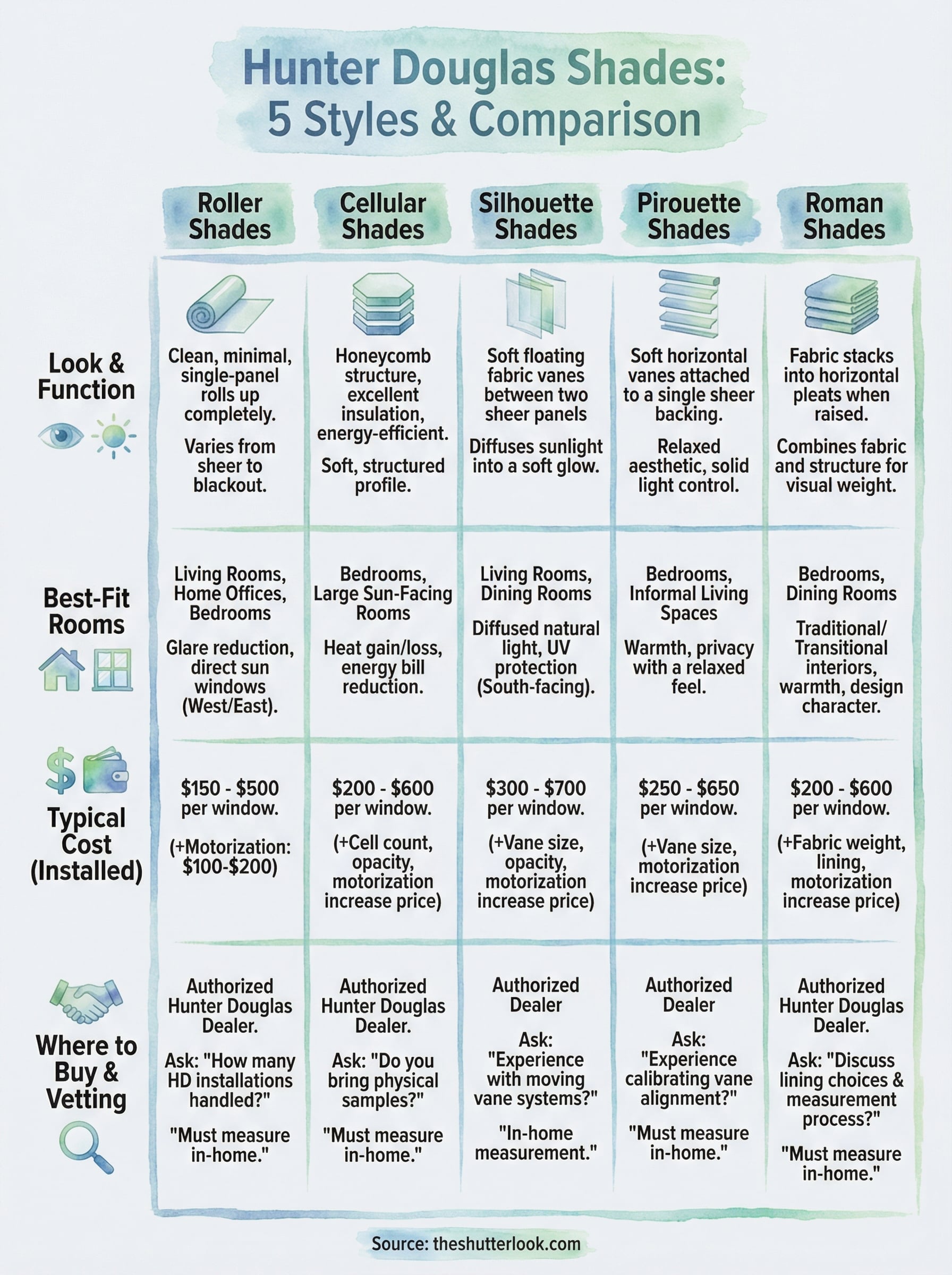
Hunter Douglas roller shades are the most popular entry point into the brand’s lineup. A single panel of fabric rolls up onto a tube mounted at the top of your window, giving you a flat, clean look that fits almost any interior style.
What you get and the look
Hunter Douglas roller shades come in hundreds of fabric options, spanning sheer, light-filtering, room-darkening, and full blackout weights. The look is minimal and modern. When fully raised, the shade disappears neatly into a compact roll, leaving your view unobstructed. There are no slats, no folds, and no layered materials.
Common fabric categories include:
- Sheer and solar screen (for glare reduction without blocking daylight)
- Light-filtering (softened light with some privacy)
- Blackout (full light block, popular for bedrooms)
Best-fit rooms and common goals
Roller shades work well in living rooms, home offices, and bedrooms where simplicity and light control matter more than decorative layering. They’re a strong pick for west- and east-facing windows that get direct sun throughout the day, since a solar screen fabric cuts glare without making the room feel closed off.
Typical cost range and what changes the price
Expect to pay $150 to $500 per window for Hunter Douglas roller shades, fully installed. Fabric type, custom sizing, and motorization all push that number up. PowerView motorization adds roughly $100 to $200 per shade on top of the base price.
Motorized roller shades need professional calibration after installation to work correctly, so factor that into your choice of installer, not just your product budget.
Where to buy and how to vet a local installer
Purchase through an authorized Hunter Douglas dealer rather than a big-box retailer if you want accurate custom sizing. Before you hire anyone, ask how many Hunter Douglas installations they’ve handled and whether they take in-home measurements before ordering. Any installer who asks you to measure your own windows is one to pass on.
2. Hunter Douglas cellular shades
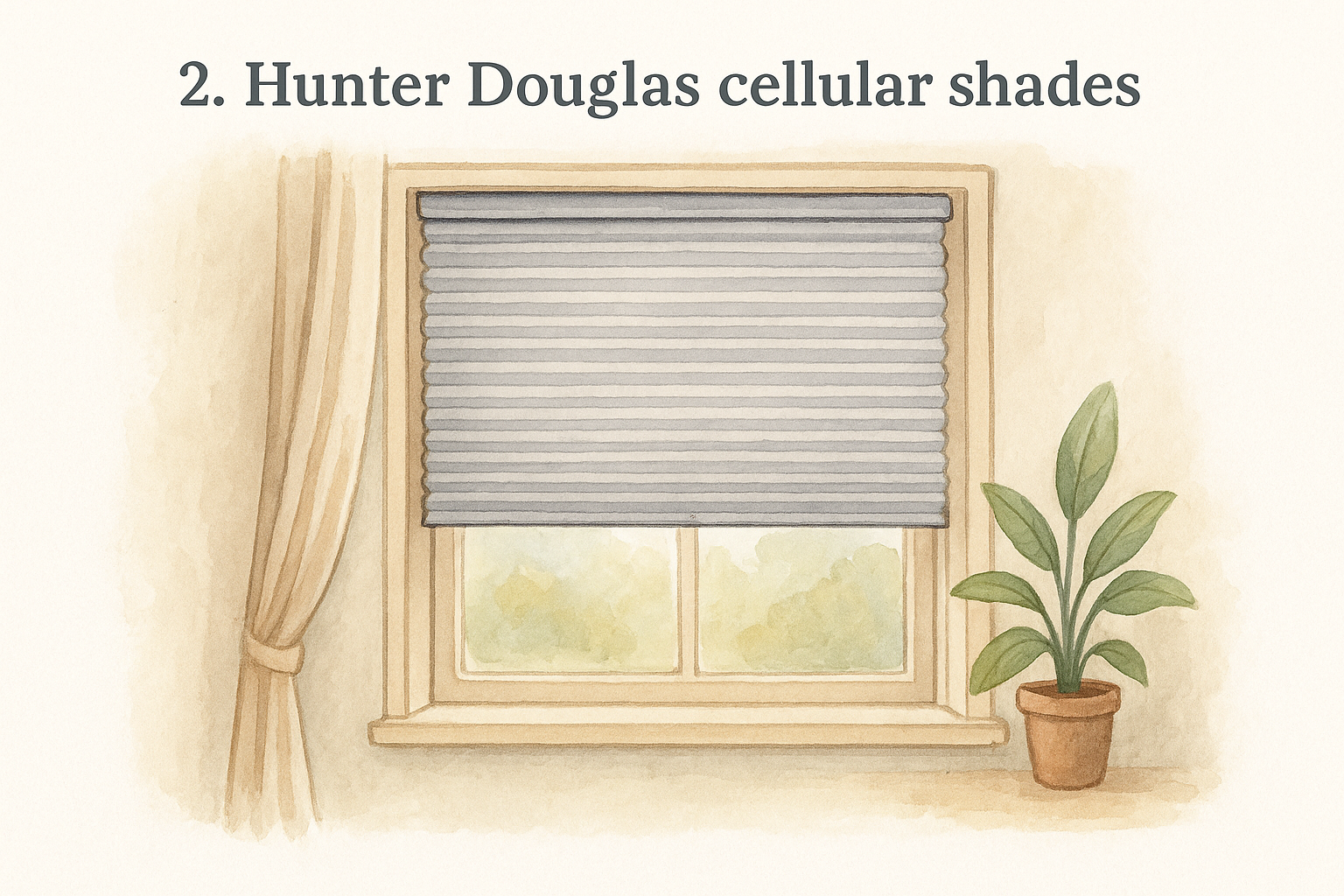
Hunter Douglas cellular shades trap air in small fabric pockets built into the material, giving you insulation and light control in one product. They’re one of the most energy-efficient options in the Hunter Douglas lineup and hold up well in climates with strong heat exposure.
What you get and the look
Cellular shades come in single-cell, double-cell, and triple-cell configurations. More cells mean better insulation. The look is soft and structured, with a clean profile that works in both traditional and modern interiors.
- Single-cell: basic insulation, lower cost
- Double/triple-cell: significantly better thermal performance
Best-fit rooms and common goals
These shades work best in bedrooms and large sun-facing rooms where heat gain or heat loss is a daily problem. If lowering your energy bills matters to you, cellular shades are worth the added investment over a basic roller or blind.
Double-cell or triple-cell configurations make the biggest difference in rooms that get intense afternoon sun.
Typical cost range and what changes the price
Expect to pay $200 to $600 per window installed. Cell count, fabric opacity, and motorization all push the price up. The Duette line, Hunter Douglas shades in their flagship cellular format, sits at the higher end of that range.
Where to buy and how to vet a local installer
Buy through an authorized Hunter Douglas dealer who brings physical fabric samples to your home. Ask whether they measure each window on-site before placing any order. A dealer who skips the in-home visit is one who’s likely to get your sizing wrong.
3. Hunter Douglas Silhouette shades
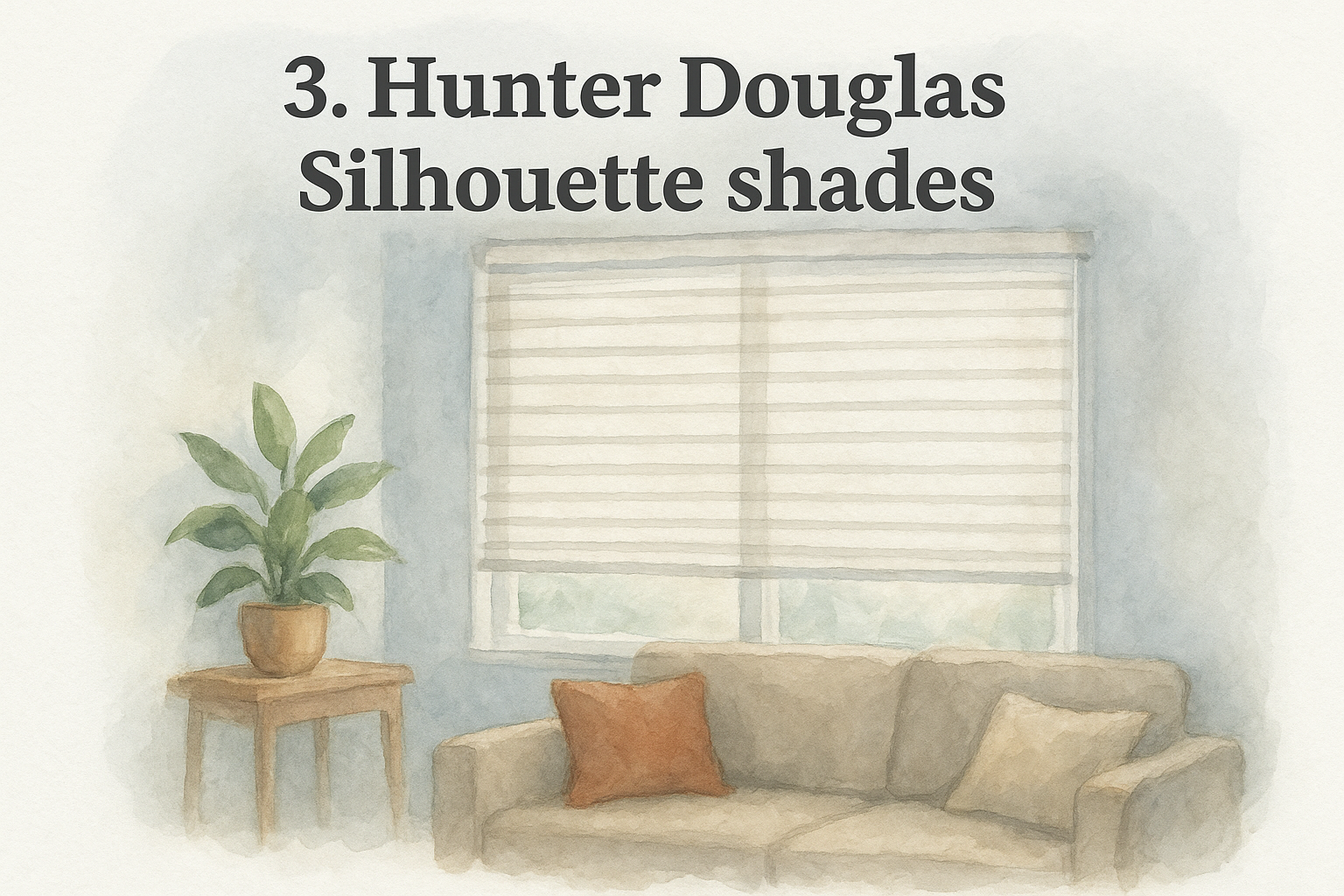
Hunter Douglas Silhouette shades sit in a category of their own. They layer soft fabric vanes between two sheer panels, giving you the ability to adjust light and visibility without choosing between a fully open or fully closed position.
What you get and the look
Silhouette shades diffuse direct sunlight into a soft, even glow while preserving your outward view. The vanes rotate to let in more or less light, so you get fine-tuned control that a standard roller or cellular shade simply cannot match.
Best-fit rooms and common goals
These shades work best in living rooms and dining rooms where you want natural light without glare hitting screens or fading furniture. They’re especially useful on south-facing windows that flood a room with direct sun for most of the day.
If light quality matters as much as light control to you, Silhouette shades are worth the premium over a basic sheer.
Typical cost range and what changes the price
Expect to pay $300 to $700 per window installed. Vane size, opacity level, and motorization all push that number higher.
Where to buy and how to vet a local installer
Buy through an authorized dealer who measures on-site. Ask specifically about their experience with Hunter Douglas shades that use moving vane systems, since alignment during installation directly affects how the shade performs long-term.
4. Hunter Douglas Pirouette shades
Hunter Douglas Pirouette shades share similarities with the Silhouette but use a single sheer backing with soft horizontal vanes attached to the front. The result is a more relaxed aesthetic with solid light control.
What you get and the look
Pirouette shades feature soft, contoured vanes that fold open to flood a room with filtered light or close to create privacy. Unlike the Silhouette, one backing panel means a slightly softer, less structured appearance overall.
- Open vanes: diffused natural light with an outward view
- Closed vanes: privacy with light still filtering through
Best-fit rooms and common goals
These shades suit bedrooms and informal living spaces where you want warmth and privacy without a heavy, room-darkening effect. They’re a strong pick for anyone who wants vane-based control in a more casual, relaxed look.
If you’re comparing Silhouette and Pirouette side by side, the single versus double sheer panel construction is the main difference to focus on.
Typical cost range and what changes the price
Expect to pay $250 to $650 per window installed. Vane size and motorization are the two factors that push that number toward the top of the range.
Where to buy and how to vet a local installer
Buy through an authorized dealer who measures on-site and ask specifically about their experience with vane-based systems before you commit.
A dealer who handles Hunter Douglas shades regularly will know how to calibrate the vane alignment during installation so everything operates smoothly long-term.
5. Hunter Douglas Roman shades
Hunter Douglas Roman shades combine fabric and structure in a way that no other shade style does. They stack into horizontal pleats as they raise, creating a look that reads more like interior design than a standard window cover.
What you get and the look
Roman shades sit flat when lowered, with no vanes or rolling mechanism. As you raise them, the fabric folds into clean horizontal stacks. Common fold styles include:
- Flat fold: clean and contemporary
- Hobbled: fuller folds for a more formal feel
Best-fit rooms and common goals
These shades work best in bedrooms and dining rooms where warmth and visual weight matter. They suit traditional and transitional interiors better than ultra-modern spaces.
Roman shades are one of the few hunter douglas shades styles where your fabric choice directly shapes the character of a room.
Typical cost range and what changes the price
Expect to pay $200 to $600 per window installed. Fabric weight and lining type drive the price most. Motorization adds another $100 to $200 per shade on top of that base cost.
Where to buy and how to vet a local installer
Buy through an authorized Hunter Douglas dealer who brings physical samples on-site. Skip any seller who asks you to self-measure.
Ask specifically about lining choices and measurement process before committing, since both affect how the shade hangs and performs long-term.
Next steps
You now have a clear picture of the five most popular hunter douglas shades styles, what each one costs, and what separates a strong installer from a weak one. The next move is straightforward: narrow your list to one or two styles that match your rooms, your light goals, and your budget before you contact anyone.
From there, prioritize dealers who bring physical samples to your home and measure on-site before placing any order. That single step eliminates most of the sizing and fabric mistakes that send buyers back to square one. If you want a team with over 23 years of experience handling custom window treatments across Central Florida, schedule a free in-home consultation with The Shutter Look. We bring the samples, take the measurements, and handle the installation so you get the result you’re expecting, not a surprise.
