


Getting your blinds to fit right starts before you ever place an order. Knowing how to measure windows for blinds matters more than most people realize, even a quarter-inch off can mean gaps, light bleed, or a return trip to the supplier. At The Shutter Look, we’ve spent over 23 years measuring and installing window treatments across Central Florida, and measurement errors are the single most common issue we see homeowners run into.
The good news? It’s not complicated once you understand the basics. The key decision comes down to whether you’re going with an inside mount or an outside mount, and each one requires a slightly different approach. Get that part right, and the rest falls into place.
This guide walks you through both methods step by step, the same process we use during our in-home consultations, so you can measure with confidence, whether you’re ordering blinds on your own or preparing for a professional installation.
What you need before you measure
Before you start learning how to measure windows for blinds, you need to gather the right tools. Measuring with a soft tape measure or a flexible ruler will give you inaccurate results, and that means ordering the wrong size. You also want to write down every measurement as you go rather than trying to remember them, because similar-looking windows are easy to mix up.
Tools you’ll need
Having the right tools on hand before you start saves you from stopping mid-measurement to hunt something down. You need a steel measuring tape, a pencil and notepad (or a notes app on your phone), and a step stool if your windows sit high on the wall. A steel tape stays rigid across wide openings, which gives you far more accurate readings than a fabric or plastic tape. Here’s what to have ready:
- Steel measuring tape (at least 25 feet)
- Pencil and paper or a notes app on your phone
- Step stool or ladder for tall or high windows
- A helper for large or awkward windows (optional but useful)
A note on accuracy
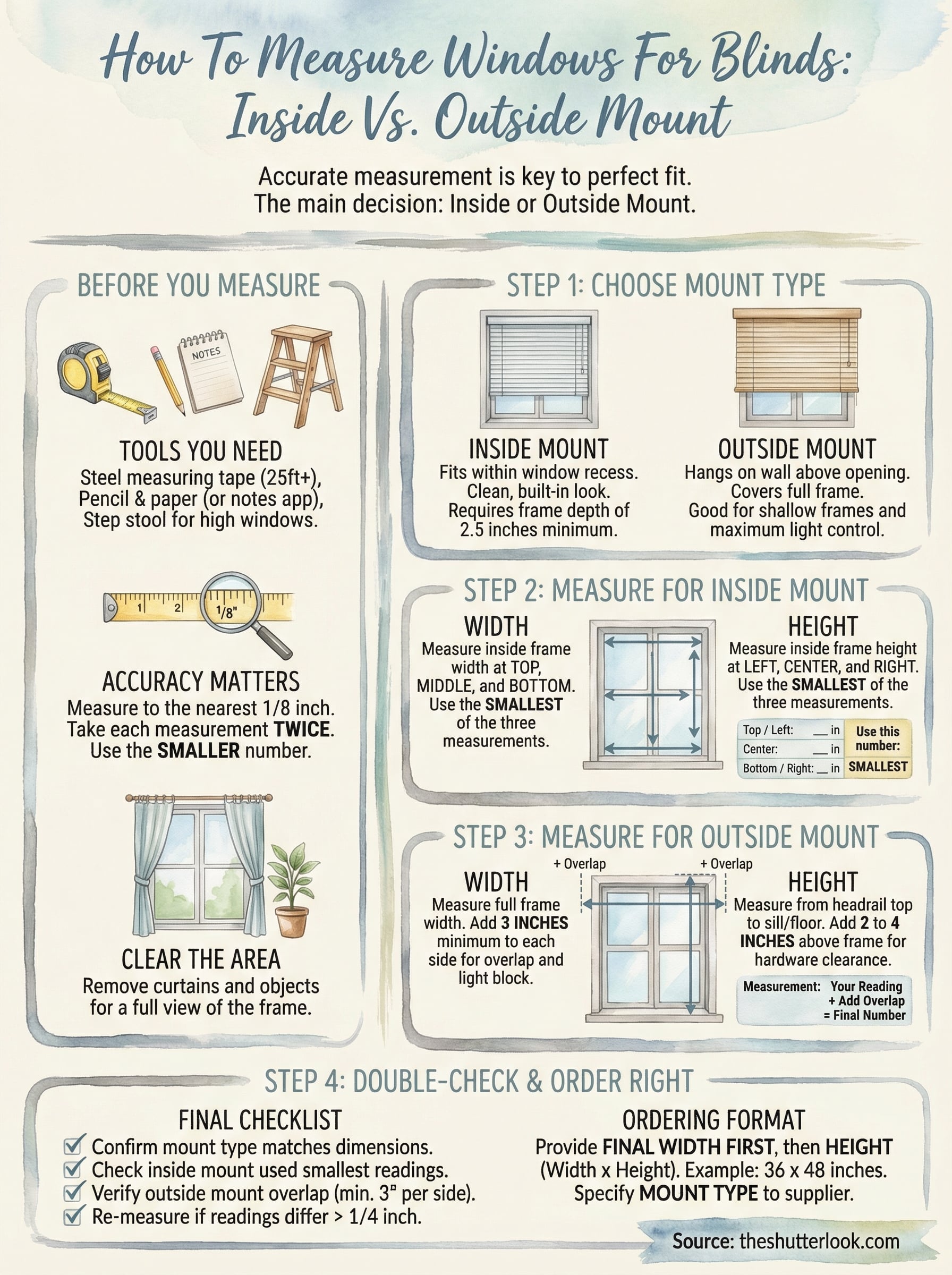
Every measurement you take should be recorded to the nearest 1/8 of an inch. That precision matters because manufacturers cut your blinds to the exact numbers you provide. A difference of even 1/4 inch can result in a blind that either won’t fit inside the frame at all or leaves visible gaps on the sides. Take each measurement at least twice, and if the two readings differ, go with the smaller number.
Always measure in inches when ordering from U.S.-based suppliers, not centimeters.
You should also clear the window area of any furniture, curtains, or objects before you start. An unobstructed view of the full frame makes each step faster and lowers the chance of a measuring error.
Step 1. Choose inside or outside mount
Your mount type determines everything that comes after. Before you learn how to measure windows for blinds, you need to decide whether your blinds will sit inside the window frame or hang on the wall outside of it. This choice affects the dimensions you record, the look of the finished product, and how well your blinds control light.
Inside mount
An inside mount fits the blind within the window recess, giving a clean, built-in look. It works best when you have a frame depth of at least 2.5 inches and no hardware obstructions near the top of the frame. Use inside mount when:
- Your frame is deep enough to hold the headrail flush
- You want the blind to look like part of the window, not an add-on
- Your trim or molding is wide enough to support the brackets
Outside mount
Outside mount hangs the blind on the wall or trim above the window opening. This option covers the full frame and any gap around it, making it the right choice when your frame is too shallow or when you want to make a small window appear larger.
If you have any doubt about frame depth, go with outside mount to avoid fit issues later.
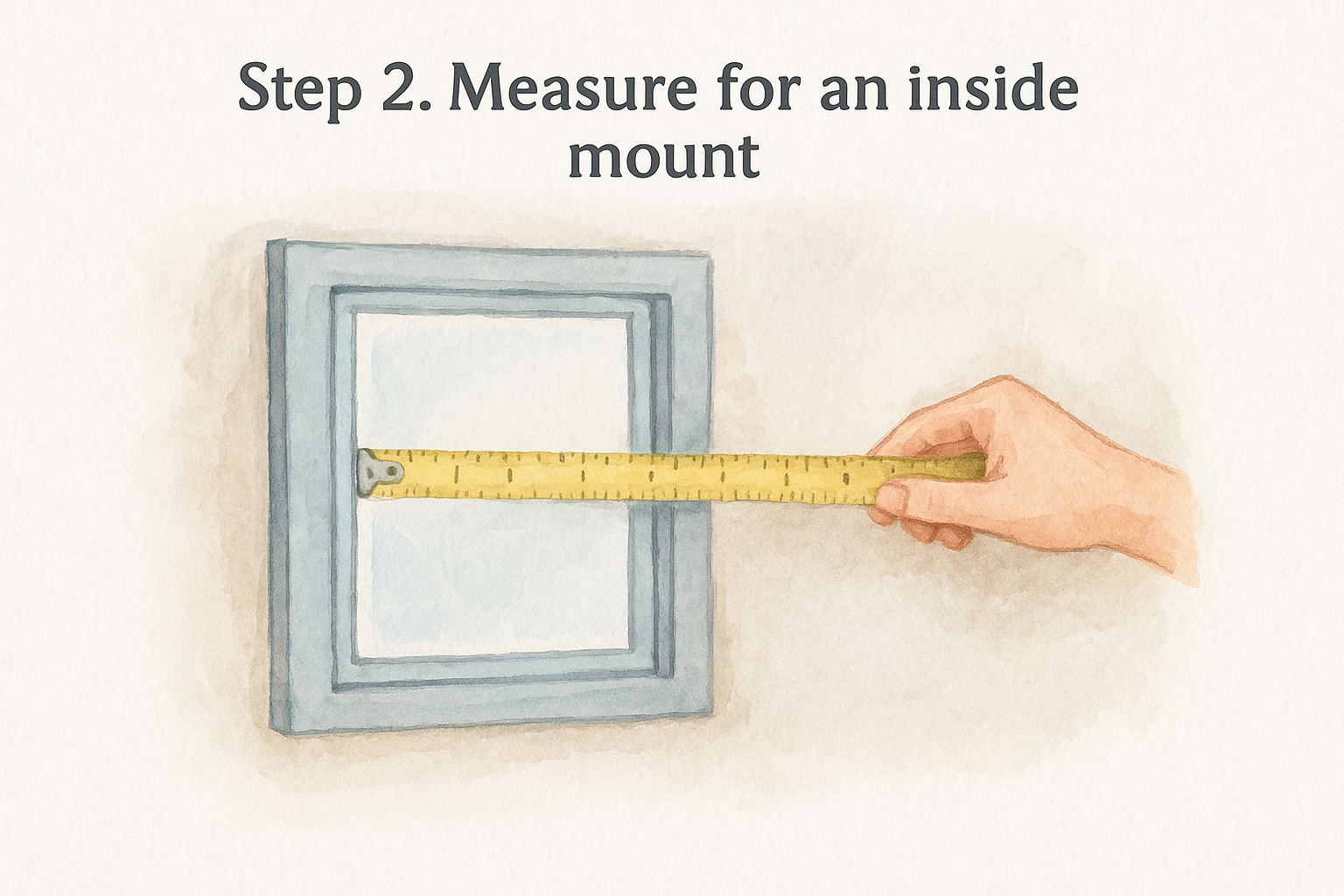
Step 2. Measure for an inside mount
Inside mount measuring requires you to record the exact interior dimensions of your window frame. When learning how to measure windows for blinds, inside mount is the trickier of the two because you’re working within a tight space, and the blind manufacturer will typically deduct a small amount for clearance automatically. Do not try to account for that deduction yourself.
Width
Measure the width of the inside frame at three points: the top, middle, and bottom of the opening. Windows are rarely perfectly square, so these three readings will often differ slightly. Use the smallest of the three width measurements when you place your order. That number ensures the blind fits through the narrowest point of the frame.
Record all three width readings before deciding which one to use, not just the first number you get.
Height
Your height measurements follow the same three-point approach. Measure the height of the inside frame on the left side, center, and right side of the opening. Use the smallest of the three height readings here as well. The table below gives you a simple template to keep every number organized before you order:
| Location | Width | Height |
|---|---|---|
| Top / Left | _____ in | _____ in |
| Center | _____ in | _____ in |
| Bottom / Right | _____ in | _____ in |
| Use this number | smallest | smallest |
Step 3. Measure for an outside mount
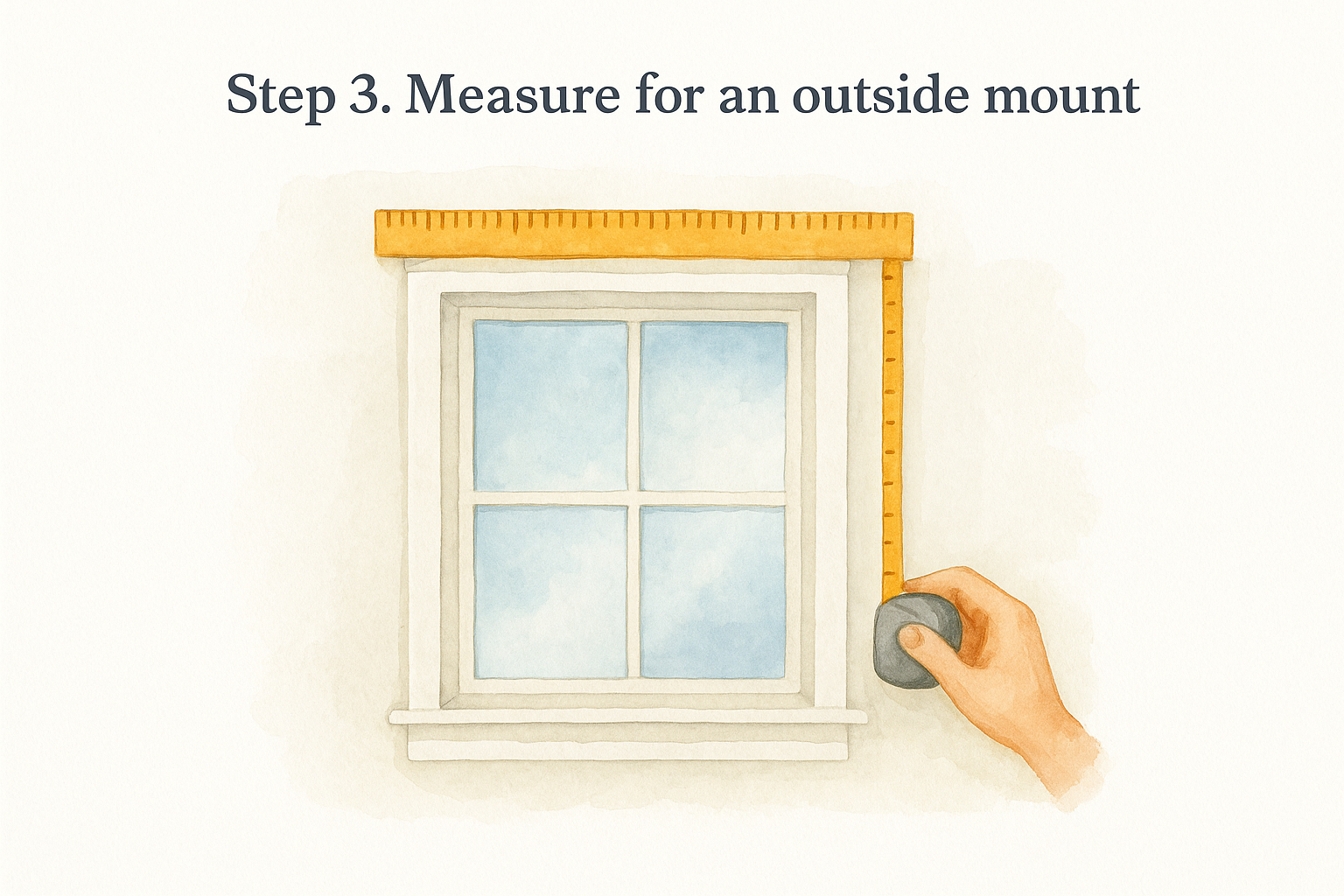
Outside mount gives you more control over final dimensions because you’re not constrained by the window frame itself. When you measure for an outside mount, you decide exactly how wide and tall the blind will be, so knowing how to measure windows for blinds this way means you need to plan for overlap on every side before you record a single number.
Width
Start by measuring the full width of the window frame, from the outer edge of the trim on one side to the outer edge of the trim on the other. Then add at least 1.5 to 3 inches on each side to ensure the blind covers the frame completely and blocks side light. A blind that is only as wide as the frame will still let light bleed around the edges.
For the best light control, add a minimum of 3 inches to each side rather than the bare minimum.
Height
Measure from the point where you plan to mount the headrail down to the windowsill or the floor, depending on how far you want the blind to drop. Add 2 to 4 inches above the frame to hide the headrail hardware and prevent light from spilling over the top. Use this template to track your outside mount numbers before ordering:
| Measurement | Your Reading | Add Overlap | Final Number |
|---|---|---|---|
| Width | _____ in | + 3 in per side | _____ in |
| Height | _____ in | + 2 to 4 in top | _____ in |
Step 4. Double-check and order the right size
You’ve recorded your measurements, but submitting the wrong number is where most ordering mistakes happen. Before you place any order, go back through every reading one more time. Knowing how to measure windows for blinds only pays off if the numbers you send to the supplier are accurate and complete.
Verify your numbers before you submit
Run through this final checklist before submitting your order to catch any errors before they become a return:
- Confirm mount type (inside or outside) matches your recorded dimensions
- Check that you used the smallest reading for inside mount width and height
- Verify outside mount overlap is at least 3 inches per side for width
- Re-measure any window where your two readings differed on the first pass
If two measurements differ by more than 1/4 inch, measure that window a third time before ordering.
What to tell your supplier
When you place your order, give your supplier the final width first, then the height. Most manufacturers list blind dimensions in that order: width x height. For example, a blind ordered at 36 x 48 inches means 36 inches wide and 48 inches tall.
Also tell them your mount type upfront, because some suppliers apply different deductions depending on whether you chose inside or outside mount. Leaving out that detail can result in a blind that does not fit correctly even with perfect measurements.
Next steps
Now you have everything you need to measure your windows accurately. Following the steps in this guide covers both inside mount and outside mount installations, so you can move forward with confidence whether you’re ordering standard blinds or a fully custom product. Learning how to measure windows for blinds correctly will save you time, money, and the frustration of dealing with a return or a sizing issue down the line.
Some windows are harder to work with than others, especially odd-shaped or arched frames and windows with existing hardware mounted near the frame. If your measurements don’t feel consistent across multiple readings, a professional consultation will remove the guesswork and give you certainty before you order.
The team at The Shutter Look has handled thousands of installs across Central Florida and offers free in-home estimates with physical product samples. Book a consultation today and get accurate measurements and expert recommendations delivered on the spot, at no cost to you.
