


If you’re considering upgrading to automated window treatments, the first question on your mind is probably motorized window shades cost. Fair enough, prices vary wildly depending on the shade style, the motor system, and whether you hire a pro or go the DIY route. Without a clear breakdown, it’s easy to either overspend or end up with a product that doesn’t hold up long-term.
At The Shutter Look, we’ve spent over 23 years installing window treatments across Central Florida, including motorized options like Neolux shades. We measure, quote, and install every project ourselves, so we know exactly where the money goes and where homeowners can save without cutting corners. That hands-on experience is what this guide is built on.
Below, you’ll find 2026 pricing by shade style, from rollers to cellular, along with a honest comparison of professional installation versus doing it yourself. Whether you’re outfitting a single room or an entire home, this breakdown will help you set a realistic budget before you commit.
Why motorized shade pricing varies so much
Motorized window shades cost more than manual shades because you’re paying for the automation system on top of the window covering itself. But the gap between the cheapest and most expensive options is wide, sometimes several hundred dollars per window. That spread exists because multiple independent variables stack on top of each other, and every choice you make adds or removes cost from the final number.
The motor system drives a big portion of the price
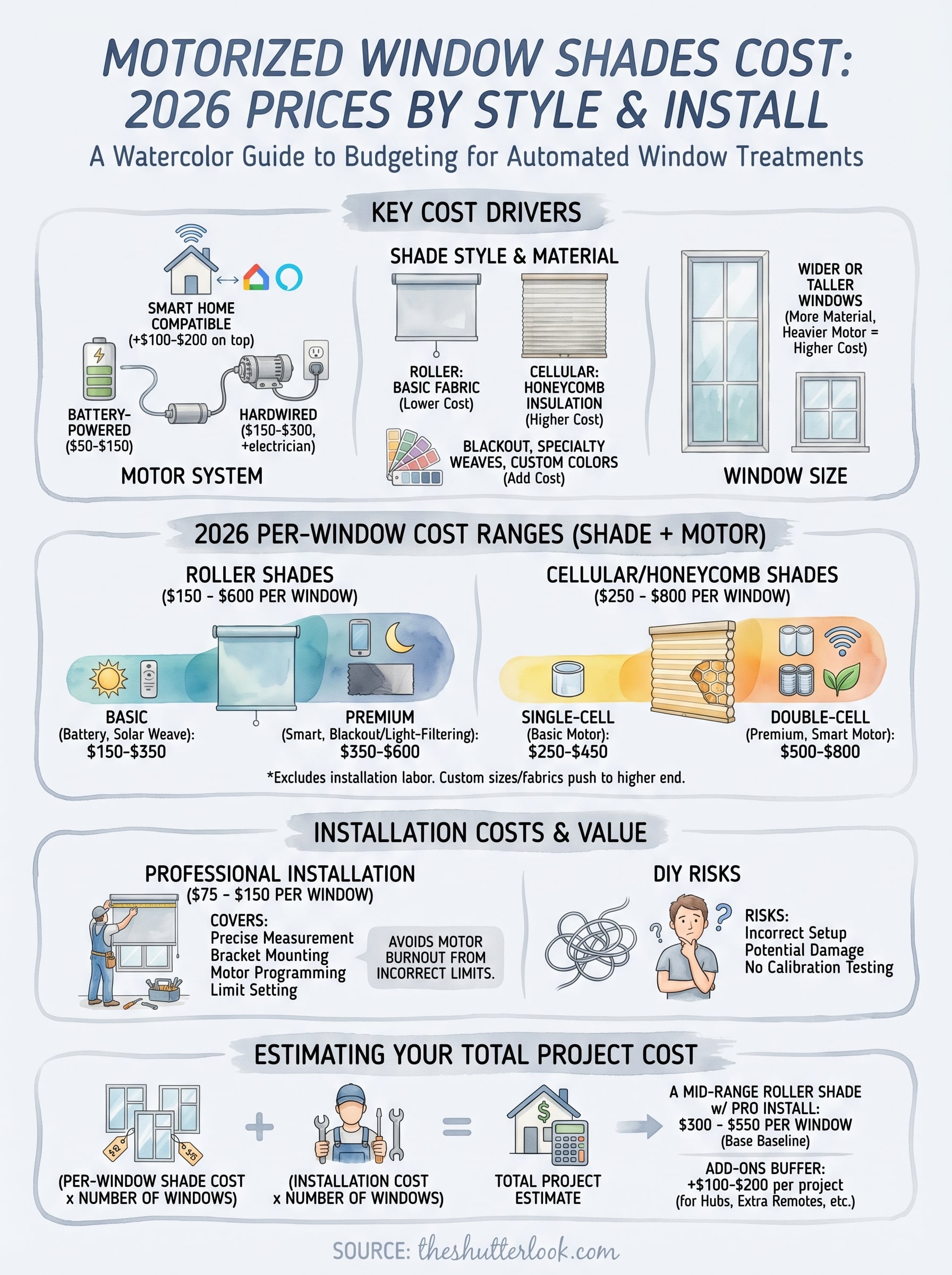
The motor is often the single most expensive component in a motorized shade. Battery-powered motors are the most accessible, typically ranging from $50 to $150 per unit, and they require no electrical work. Hardwired motors cost more upfront, often $150 to $300 per unit, but you may also need an electrician to run wiring if outlets aren’t already in place. Smart home-compatible motors, those that connect to systems like Google Home or Amazon Alexa, sit at the top of the range and can add another $100 to $200 per window on top of the base motor price.
If you’re building or remodeling, roughing in wiring before walls close is significantly cheaper than retrofitting it later.
Material, size, and shade style also shift the price
Your choice of shade material and operating style affects cost just as much as the motor. A basic roller shade in a standard polyester fabric starts low, often under $200 per window for the shade alone, while a cellular or honeycomb shade in a premium fabric can run $300 to $600 per window before installation. Wider or taller windows push costs higher because they require larger shade panels and sometimes heavier-duty motors to handle the additional weight. Blackout linings, specialty weaves, and custom colors all add to the base price as well.
2026 cost ranges per window by shade style
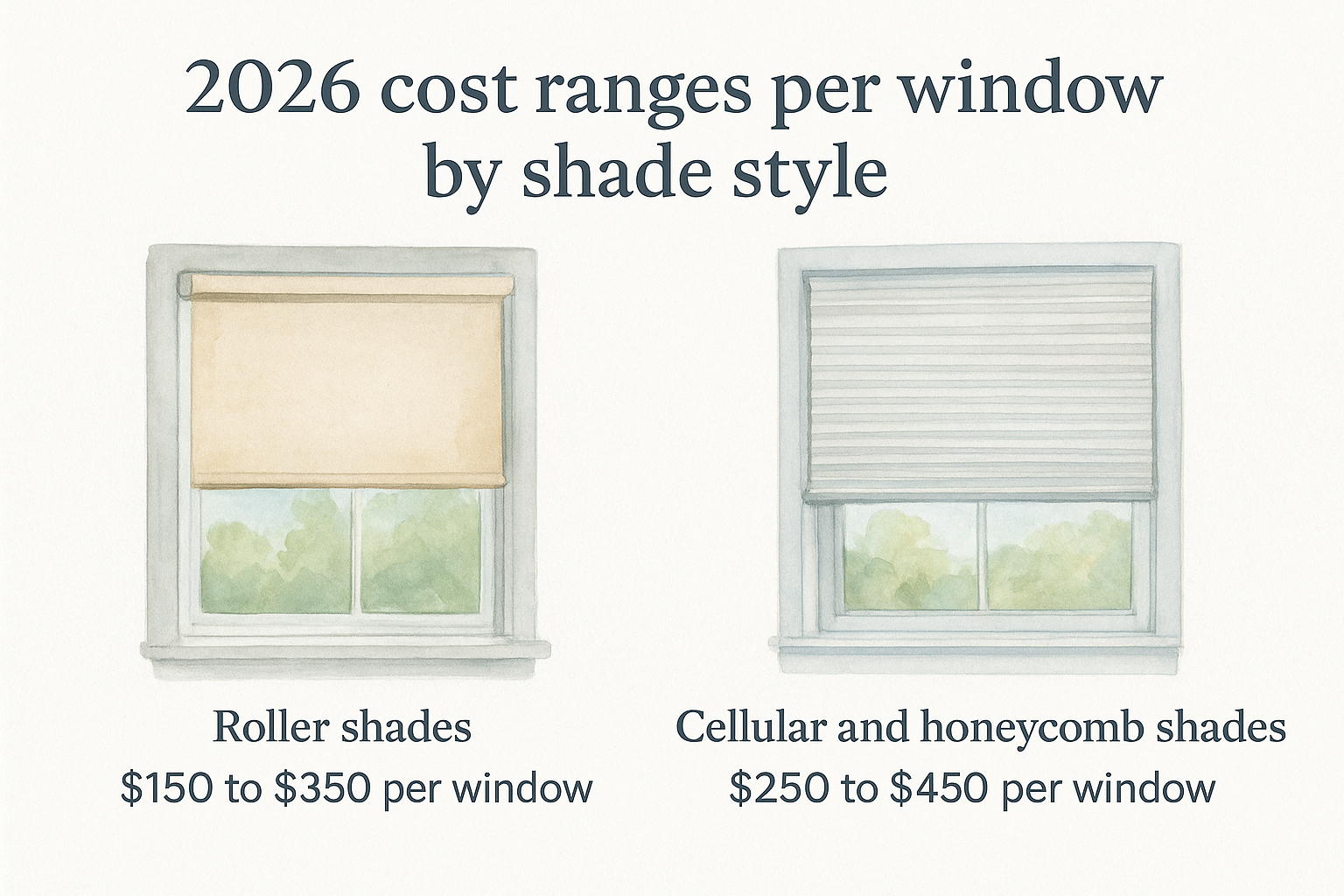
Understanding motorized window shades cost by shade type helps you build a realistic budget before requesting quotes. The numbers below cover per-window pricing for the shade and motor combined, excluding installation labor. Custom sizes, specialty fabrics, and smart-home-compatible motors push these numbers toward the higher end of each range.
Roller shades
Roller shades are the most affordable motorized option available in 2026. A basic motorized roller with a battery-powered motor runs $150 to $350 per window. Step up to a blackout or light-filtering fabric paired with a smart-home motor, and that range climbs to $350 to $600 per window. Wider or taller windows add cost because they require larger panels and sometimes heavier motors.
Roller shades in a solar weave fabric are a practical pick for living rooms or home offices where you want daylight without direct glare hitting screens or furniture.
Cellular and honeycomb shades
Cellular shades carry a higher price point because the honeycomb structure provides genuine insulation, which matters significantly in Florida’s heat. A single-cell motorized cellular shade runs $250 to $450 per window for the shade and motor combined.
Double-cell versions with premium fabric and smart motors reach $500 to $800 per window. That higher upfront cost can offset itself over time through reduced energy bills, especially on south- or west-facing windows that absorb the most direct sun exposure throughout the day.
2026 installation costs and what installers include
Professional installation adds to your overall motorized window shades cost, but it covers more than just mounting hardware to a wall. Most installers charge between $75 and $150 per window, with prices varying based on window height, accessibility, and the complexity of the motor or smart-home integration involved.
What the installation fee covers
A professional installer handles precise measurement, bracket mounting, and motor programming as part of the job. That means your shades arrive cut to the correct dimensions, hang level, and respond properly to your remote or app from day one. Battery-powered motor installs also include setting the upper and lower limit stops, which control exactly how far each shade travels and protect the motor from overextension.
Skipping professional installation on motorized shades is riskier than skipping it on manual shades, because incorrect limit settings can burn out a motor over time.
Why professional installation matters beyond setup
Installers test every shade under real operating conditions before they leave, catching pairing or calibration issues on the spot rather than leaving you to troubleshoot later. With hardwired motors, a licensed installer also coordinates with your electrician to confirm the wiring meets local building code, which is important if you ever plan to sell the home or pull a permit for the work.
How to estimate your total project cost
Estimating your total motorized window shades cost starts with a simple formula: multiply your per-window shade cost by the number of windows, then add installation labor on top. A mid-range motorized roller shade with professional installation lands between $300 and $550 per window in 2026, giving you a reliable baseline for a first-pass budget.
Count your windows and group them by type
Start by listing every window you want to treat and noting the approximate width and height of each one. Group windows by room and function: bedrooms where blackout matters most, living areas where light filtering fits better, and any oversized windows that require heavier motors or wider panels. That grouping makes it easier to apply different price tiers across your home rather than using one flat number for everything.
Treating a full home in phases rather than all at once lets you spread costs over time without sacrificing quality on individual windows.
Build in a buffer for add-ons
Standard quotes often exclude hub devices, extra remotes, or smart-home bridge equipment if you’re integrating shades into a system like Google Home. Set aside an extra $100 to $200 for these accessories per project. Common add-ons that homeowners miss when budgeting include:
- Smart home bridge devices
- Additional hand-held remotes
- Electrical outlet installation for hardwired motors
Questions to ask before you buy
Before committing to a purchase, asking the right questions protects your motorized window shades cost investment and helps you avoid surprises after installation day. A few targeted questions separate the vendors worth hiring from those who will leave you troubleshooting on your own.
What to ask about the product itself
Ask your vendor whether the motor is battery-powered or hardwired, and confirm what that means for your specific walls and windows. You also want to know the warranty coverage on both the shade fabric and the motor separately, since the two often carry different terms.
Asking for warranty documentation before you sign anything gives you leverage if something fails after installation.
- Does the motor work with your existing smart home system?
- What happens if the motor fails after the warranty period?
- Are replacement parts available, or does the whole unit need replacing?
What to ask your installer
Confirm that your installer handles both measurement and programming as part of the quoted price, not as add-ons. Ask whether they test every shade in operating condition before leaving your home.
Those two questions alone reveal whether you’re dealing with an experienced installer or someone cutting corners. An honest installer gives you straightforward answers on both points without hesitation, which tells you a lot about how they’ll handle the full project.
Next steps
Now you have a clear picture of what motorized window shades cost across different styles, motor types, and installation scenarios. Use the per-window ranges from this guide to build your first budget draft, then get at least two quotes from local installers to see where your specific windows land within those ranges.
Your next practical move is to walk through your home and list every window you want to treat. Note the dimensions, room function, and whether you need blackout, light filtering, or solar fabric in each space. That information gives any vendor enough detail to quote you accurately on the first visit rather than sending a vague estimate that shifts later.
If you’re in Central Florida and want professional measurement and honest pricing with installation handled by one expert from start to finish, schedule a free in-home estimate with The Shutter Look and get exact numbers for your home before you commit to anything.
