


If you’re shopping for new window treatments, one of the first questions on your mind is probably what custom window shades cost in 2026. The answer isn’t as simple as a single price tag. Materials, sizing, operating mechanisms, and installation all play a role in the final number, and the range between a basic roller shade and a fully motorized cellular shade can be significant. Without clear pricing benchmarks, it’s easy to either overspend or underestimate what a quality setup actually requires.
At The Shutter Look, we’ve spent over 23 years helping Central Florida homeowners choose and install window treatments that fit their homes and their budgets. Every project we take on starts with a free in-home estimate, where we bring physical samples, take precise measurements, and walk through real pricing, no guesswork involved. That hands-on experience across thousands of installations gives us a grounded perspective on what things actually cost and why.
This guide breaks down current 2026 pricing for custom window shades, covers the major factors that push costs up or down, and explains what to expect from professional installation fees. Whether you’re outfitting a single room or an entire house, you’ll walk away with the numbers you need to plan your budget with confidence.
Why custom window shade pricing varies so much
When homeowners start asking about custom window shades cost, they often expect a straightforward answer. The reality is that pricing depends on a combination of variables that interact with each other. The material you choose, the operating mechanism, the dimensions of your windows, and whether you opt for professional installation all shape the final number. Understanding what drives those differences helps you make smarter decisions from the start rather than getting surprised at checkout.
The type of material changes everything
The shade fabric or material is the single biggest variable in the price you’ll pay per window. Roller shades made from basic polyester sit at the lower end of the cost spectrum, while cellular (honeycomb) shades built with multi-layer fabric or specialty materials can cost three to four times more. Woven wood shades, solar shades with specific openness factors, and true blackout fabrics each carry their own pricing tier based on manufacturing complexity and raw material costs.
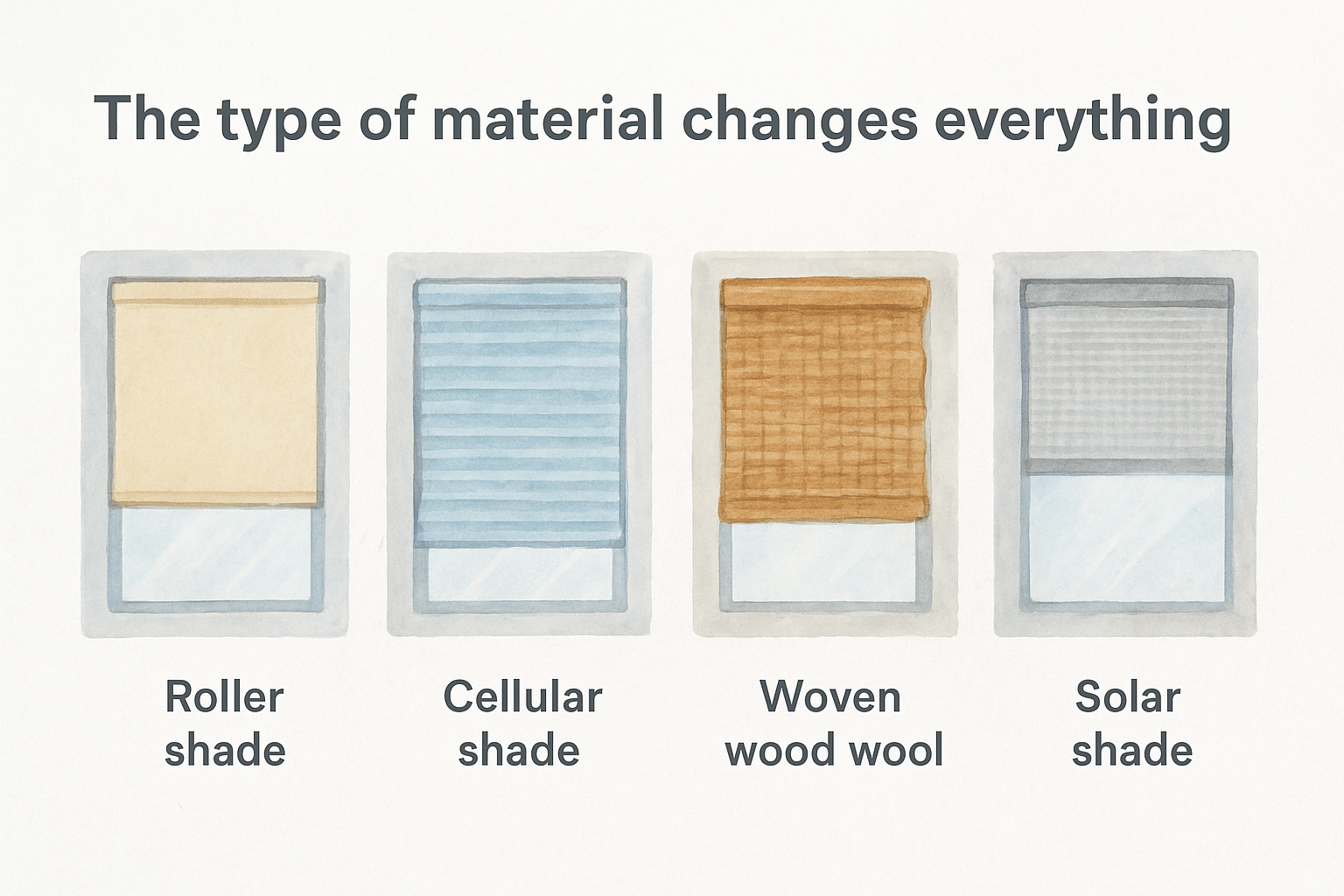
Beyond the base fabric, material quality directly affects durability and long-term performance. A less expensive fabric may handle light filtering well in a low-traffic guest room, but in a kitchen or family room where the shade gets pulled up and down multiple times daily, a higher-grade material pays for itself over time. Choosing the right material for the right room is a decision worth making before you commit to anything.
The material you select will have a larger impact on your long-term satisfaction than almost any other single factor in the purchasing process.
Size and window count multiply your total
Window dimensions are a straightforward cost driver: wider and taller windows require more fabric, heavier hardware, and sometimes additional structural support. A 24-inch wide shade for a standard bedroom costs considerably less than a 72-inch wide shade covering a sliding glass door or a wide picture window. Custom sizing also means no off-the-shelf solutions apply, so every measurement directly affects the final price.
Outfitting multiple rooms amplifies every per-unit cost in ways that can catch homeowners off guard. A home with 15 to 20 windows will see those individual costs stack up quickly, which is why many homeowners prioritize rooms by need rather than replacing all treatments at once. Breaking the project into planned phases can make the overall investment more manageable without forcing you to compromise on product quality.
Operating mechanism and added features
How a shade opens and closes has a real impact on price. Cordless lift systems cost more than standard corded mechanisms, but they deliver a cleaner look and are significantly safer in homes with young children. Motorized shades sit at the top of the pricing range because they incorporate an electric motor, often paired with a remote or smart home integration, which requires premium components and more involved installation work.
Specialty features like top-down/bottom-up operation, where you lower a shade from the top while keeping the bottom raised for privacy, also add to the per-unit cost. Room-darkening liners, moisture-resistant treatments for bathrooms and laundry rooms, and UV-protective coatings each layer on additional expense. Before assuming you need every available option, consider which features actually solve a specific problem in each room rather than adding them across the board.
2026 custom window shades cost per window
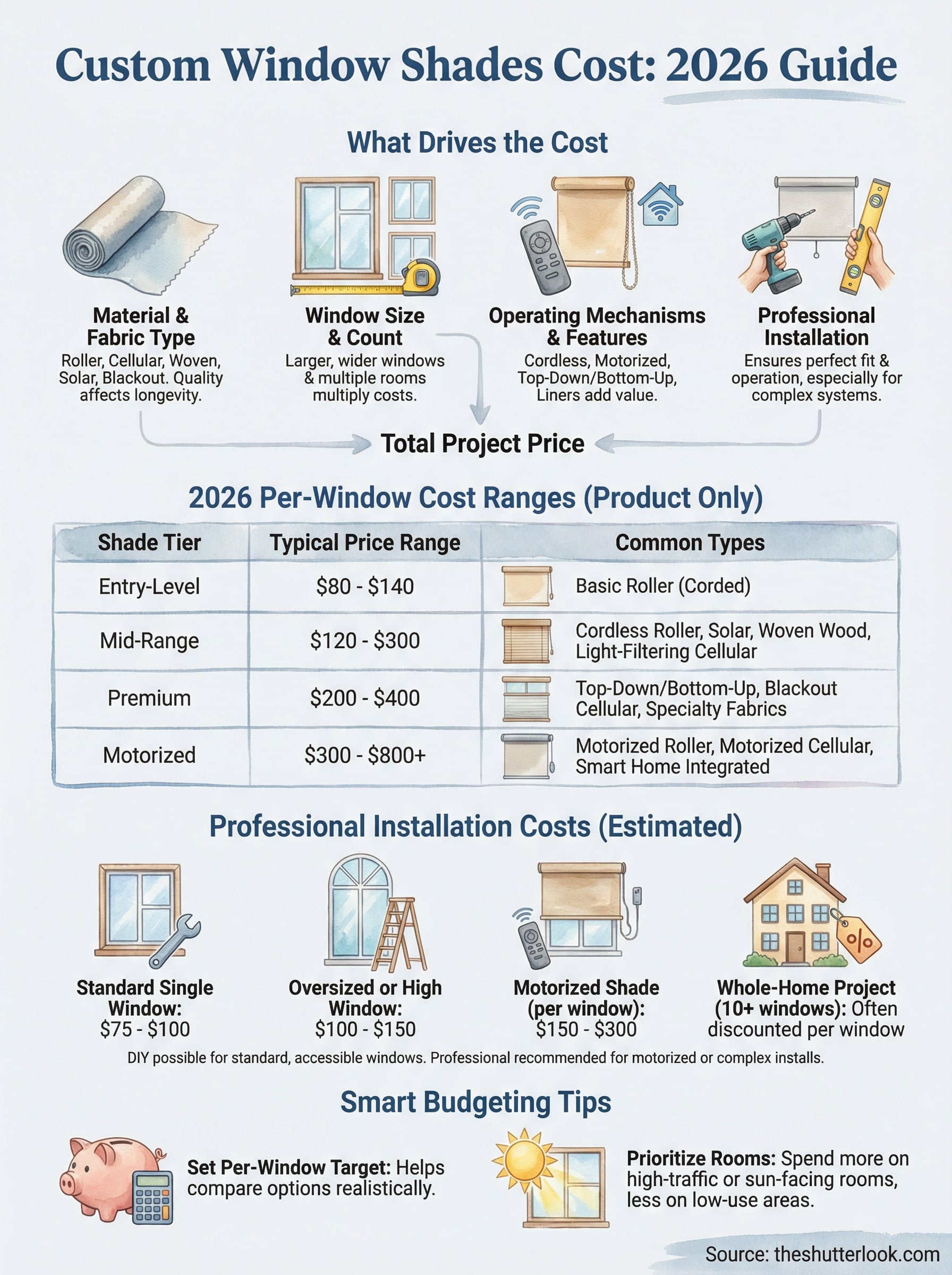
Knowing the actual price ranges before you shop helps you set a realistic budget and avoid surprises. The custom window shades cost per window in 2026 typically runs between $80 and $800, depending on the shade type, material grade, and operating system you choose. That range exists because a corded roller shade and a motorized blackout cellular shade are fundamentally different products, and treating them as comparable would set you up for sticker shock at either end.
Entry-level and mid-range shades
Roller shades and solar shades represent the most common entry-level choice, with per-window costs generally landing between $80 and $220 for standard sizes. Corded versions sit at the lower end of that range, while cordless lift systems add a modest premium. Woven wood shades and light-filtering fabric shades typically fall in the $150 to $300 range per window, depending on material weight and window width.
Here is a breakdown of common shade types and their 2026 per-window cost ranges:
| Shade Type | Per-Window Cost Range |
|---|---|
| Basic roller shade (corded) | $80 – $140 |
| Cordless roller shade | $120 – $200 |
| Solar shade | $100 – $220 |
| Woven wood shade | $150 – $300 |
| Cellular (honeycomb) shade | $150 – $350 |
| Top-down/bottom-up shade | $200 – $400 |
| Motorized shade | $300 – $800+ |
These figures represent product costs only; professional installation fees are separate and covered in a later section.
Premium and motorized options
Cellular shades with double or triple honeycomb construction sit at the top of the non-motorized category, typically running between $150 and $350 per window. Their insulating properties make them a strong choice for rooms with significant heat gain or loss, and many homeowners find the long-term energy savings offset the higher upfront cost.
Motorized shades carry the largest per-unit investment, with costs commonly landing between $300 and $800 depending on the motor type, shade fabric, and smart home compatibility. On whole-home projects with 10 or more motorized units, many professional installers offer volume pricing that brings the per-window average down, so it’s worth asking about that when you request a quote.
What drives your total cost at home
When you move from per-window pricing to your actual project total, a few home-specific factors take over. The overall custom window shades cost for your home depends on how many windows you’re covering, how large those windows are, and what you need each shade to actually do. Getting clear on these before you request a quote puts you in a much stronger position to avoid surprises.
Number of windows and room priority
How many windows you plan to cover has the most direct impact on your total investment. A single bedroom upgrade might involve two or three windows, while a full home project could mean 15 or more. Prioritizing rooms based on where light control or privacy matters most gives you a practical way to phase the project and manage costs without cutting corners on quality. A living room facing west gets brutal afternoon sun; that’s a room where spending more on a quality shade pays off immediately.
Tackling your highest-priority rooms first lets you experience the product in your home before committing to the rest of the house.
Window size and configuration
Standard window sizes cost less to cover than oversized or uniquely shaped windows. Wide picture windows, floor-to-ceiling panels, and angled architectural windows all require more material and sometimes custom hardware that adds to the per-unit price. Sliding glass doors present a particularly common scenario in Florida homes where standard shade widths often fall short, pushing you toward wider single shades or multi-panel configurations.
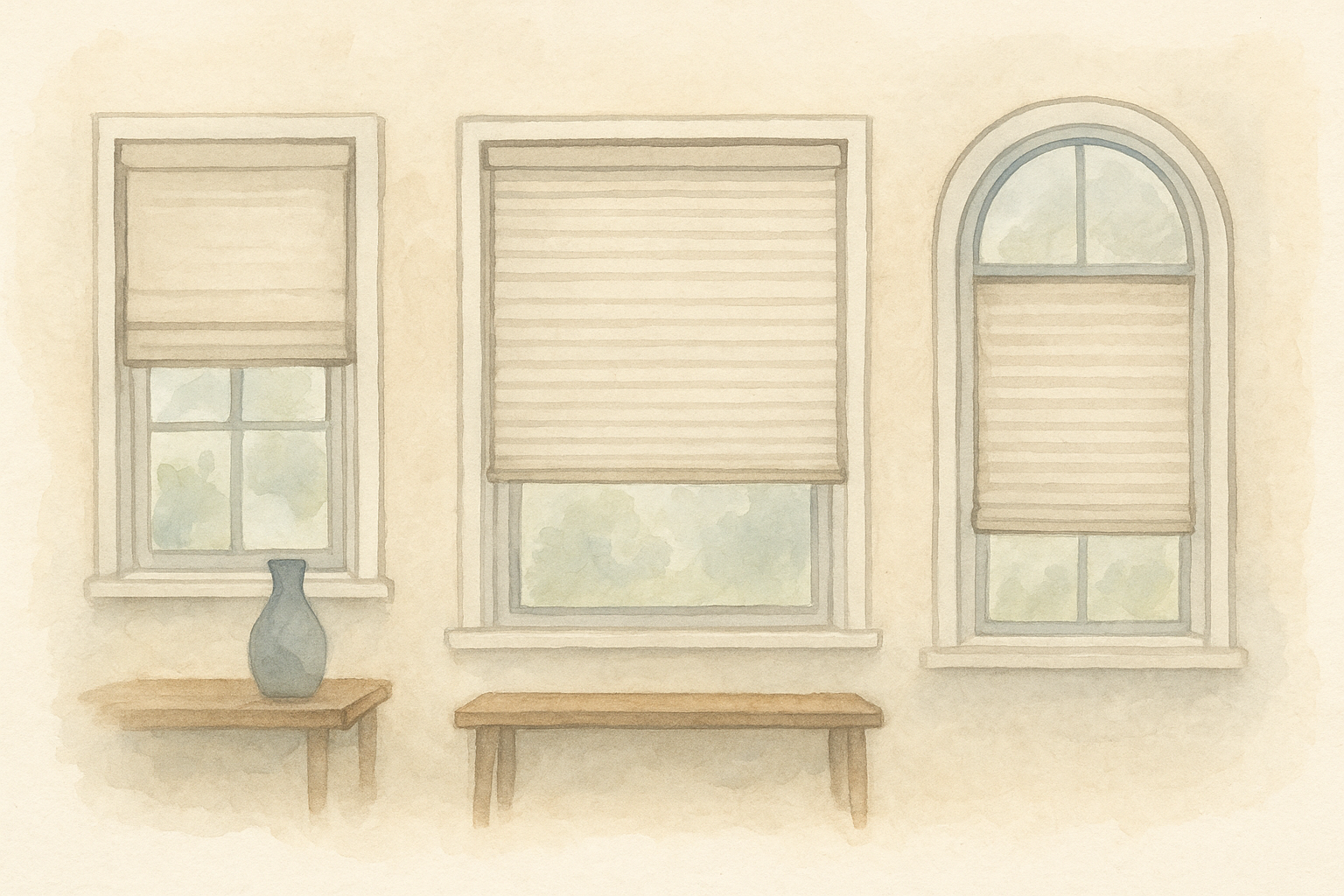
Bay windows and arched windows introduce additional complexity because each section typically needs its own independently measured treatment. If your home has several non-standard configurations, factor in a higher per-window average when building your initial budget.
Light control and privacy needs
What you need the shade to do in each room affects which product you select and, by extension, what you spend. A home office might need strong glare reduction without full blackout, making a solar shade a practical fit. A bedroom used for daytime sleeping calls for a true blackout liner, which adds cost but solves the problem completely.
Rooms like bathrooms and kitchens also introduce moisture and humidity considerations, which push you toward materials rated for those environments. Matching the right shade to each room’s specific function keeps you from replacing treatments early because the wrong product wore out faster than expected.
Installation costs and DIY vs pro install
Installation is the part of custom window shades cost that homeowners most often forget to factor in upfront. Professional installation fees vary based on the number of windows, the complexity of mounting, and your geographic area, but budgeting for it from the start gives you a more accurate picture of what the full project actually costs.
What professional installation typically costs
Professional installation fees for window shades generally run between $75 and $150 per window for standard mounting in a typical home. Single-story homes with easy window access sit toward the lower end of that range, while two-story homes, high ceilings, or tricky architectural configurations push costs higher. Motorized shades carry an additional wiring and programming cost that can add $50 to $150 per unit on top of the standard installation rate.
Here is a general breakdown of what to expect for professional installation:
| Scenario | Estimated Installation Cost |
|---|---|
| Standard single window | $75 – $100 |
| Oversized or high window | $100 – $150 |
| Motorized shade (per window) | $150 – $300 |
| Whole-home project (10+ windows) | Often discounted per window |
Many professional installers offer reduced per-window rates on larger projects, so always ask about volume pricing before assuming the single-window rate applies across the board.
When DIY makes sense and when it doesn’t
DIY installation is a realistic option for standard roller shades or cordless cellular shades on straightforward double-hung or casement windows. Manufacturers typically provide mounting hardware and step-by-step instructions, and a basic installation requires nothing more than a drill, a level, and accurate measurements. If your windows are standard sizes with flat, accessible frames, DIY can save you a meaningful amount on a smaller project.
Motorized shades, heavy oversized panels, and windows with unusual framing or high placements are a different situation. Incorrect mounting on a wide or heavy shade creates alignment problems that affect how the shade operates over time, and fixing those issues after the fact costs more than getting it right the first time. For any project involving motorized units or non-standard window configurations, professional installation protects both your investment and your time.
How to budget and save without sacrificing quality
Building a realistic plan for custom window shades cost starts before you ever look at a product catalog. Knowing your total window count, identifying which rooms need the most attention, and understanding the difference between features you genuinely need versus ones that sound appealing in a showroom all help you keep your spending focused on what actually improves your home rather than inflating a bill unnecessarily.
Set a per-window target before you shop
Starting with a per-window budget gives you a practical framework for comparing options without getting overwhelmed. If your overall budget for a 10-window project is $3,000, that works out to $300 per window for product and installation combined. That number immediately tells you that a mid-range cordless cellular shade with professional installation is a realistic fit, while motorized shades across every window would push you over budget unless you phase the project over time.
Knowing your per-window ceiling before you walk into a consultation keeps you from falling in love with options that don’t fit your plan.
Once you have that number in mind, you can make deliberate trade-offs rather than reactive ones. Spending more on a high-traffic living room shade and less on a guest room you use twice a year is a smarter allocation than splitting the budget evenly across every window regardless of use or function.
Focus your spend where it matters most
Not every window in your home carries the same need. West-facing windows that take direct afternoon sun deserve a higher-quality, better-performing shade than a north-facing hallway window that gets almost no direct light. Identifying your high-priority windows and allocating more of your budget there protects you from under-buying where it actually counts and over-buying where it doesn’t.
Moisture-prone rooms like bathrooms and laundry rooms also deserve materials rated for humidity resistance, even if that costs a bit more per unit. Choosing the wrong material in those rooms leads to early replacement, which costs more in the long run than spending appropriately the first time. Matching the product to the room’s actual conditions is one of the most practical ways to protect your investment without adding unnecessary features across windows where a simpler solution works just as well.
Next steps to price your shades
You now have a solid foundation for understanding custom window shades cost, from per-window price ranges to installation fees and room-by-room prioritization. The next step is turning that knowledge into a real quote based on your actual windows, your specific rooms, and the features that matter most to your household. General pricing guides give you a framework, but your home’s measurements, configurations, and material choices will determine the number that actually shows up on your invoice.
The most straightforward way to move forward is to schedule a free in-home consultation where someone brings physical samples to your space, takes precise measurements, and gives you real pricing on the spot. That eliminates guesswork entirely. If you’re in Central Florida and want an accurate, no-pressure estimate from a team with over 23 years of installation experience, contact The Shutter Look for a free in-home estimate and get the exact numbers your project needs.
