


Getting accurate measurements is the single most important step before ordering plantation shutters. Even a quarter-inch mistake can mean gaps, light bleed, or shutters that simply won’t fit your window frame. If you’re wondering how to measure for plantation shutters, you’re already ahead of most homeowners who skip straight to picking colors and louver sizes, only to deal with costly reorders or awkward installations later.
The process isn’t complicated, but it does require attention to detail. You’ll need to decide between an inside mount and an outside mount, and each option has its own measurement method. Inside mounts sit flush within the window frame for a clean, built-in look. Outside mounts attach to the wall or trim surrounding the window, which works well for shallow frames or when you want broader light-blocking coverage. The measurements you take will differ depending on which route you choose, so understanding both approaches matters.
At The Shutter Look, we’ve spent over 23 years measuring, fitting, and installing plantation shutters across Central Florida. Our owner handles every project personally, from the first in-home consultation to the final screw. That hands-on experience has shown us exactly where DIY measurements tend to go wrong and what you can do to get them right the first time. Whether you plan to measure on your own or just want to understand the process before scheduling a free estimate, this guide walks you through everything step by step.
Before you start: mount style, depth, and obstructions
Before you grab a tape measure, you need to make two key decisions that will shape every number you record: whether you want an inside mount or an outside mount, and whether your window can actually support the option you prefer. Skipping this step is one of the most common mistakes homeowners make when figuring out how to measure for plantation shutters. Your answers here determine which measurements matter, what dimensions you record, and how to account for anything blocking the window.
Choosing inside mount vs. outside mount
Your mount style is a practical decision, not just an aesthetic one. Inside mount shutters sit inside the window opening and deliver a clean, built-in appearance that frames the glass without covering surrounding trim or wall space. Outside mount shutters attach to the wall, trim, or the face of the frame around the opening, which works better when your frame is too shallow, when hardware sits inside the opening, or when you want broader light-blocking coverage. Consider these factors when deciding:
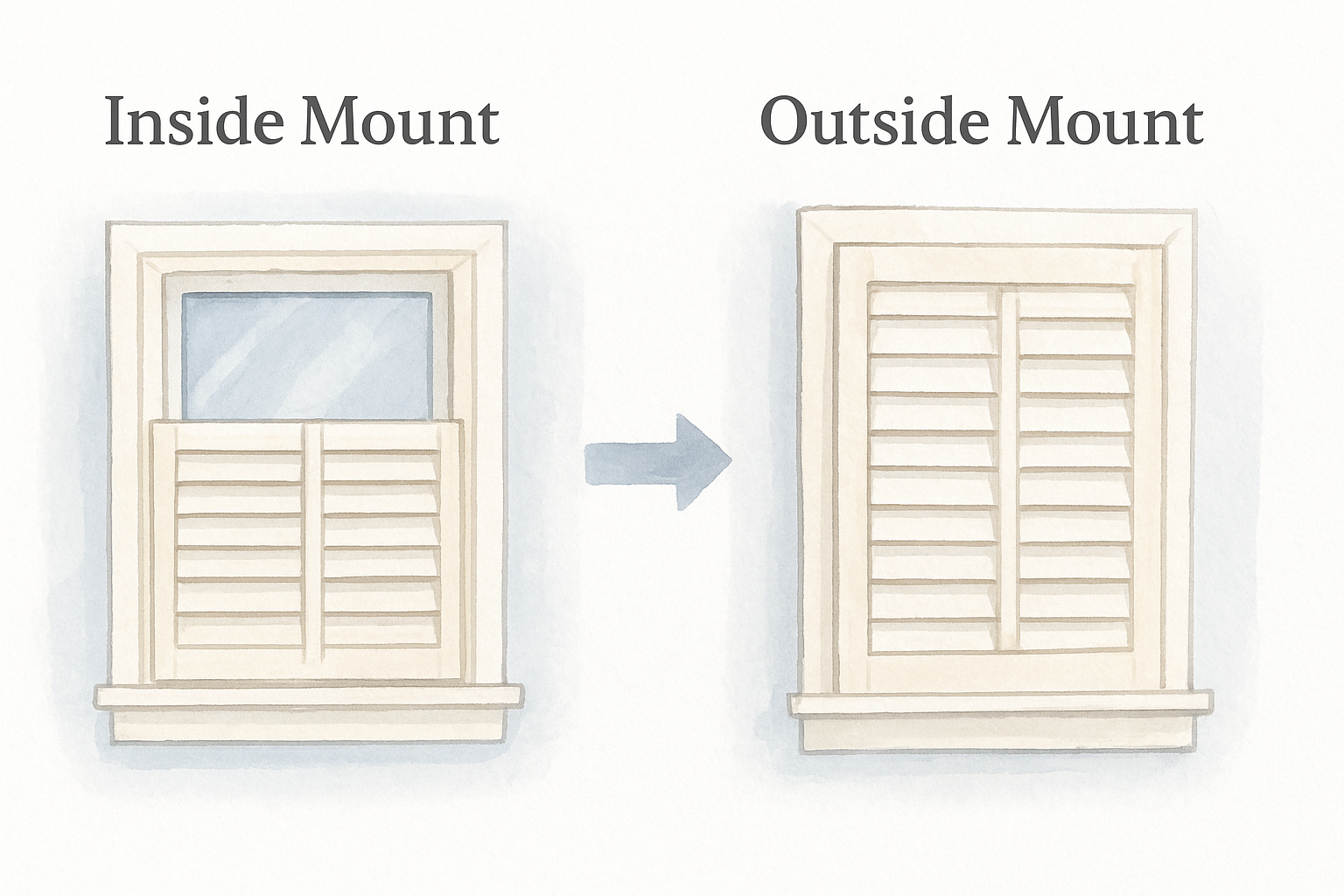
- Inside mount: cleaner look, requires adequate frame depth, limited by obstructions inside the opening
- Outside mount: better light coverage, works on shallow or irregular frames, hides imperfections around the window
Your mount style determines not just what you measure, but how much room for error you actually have before the shutter won’t fit or function correctly.
Check your frame depth for inside mount
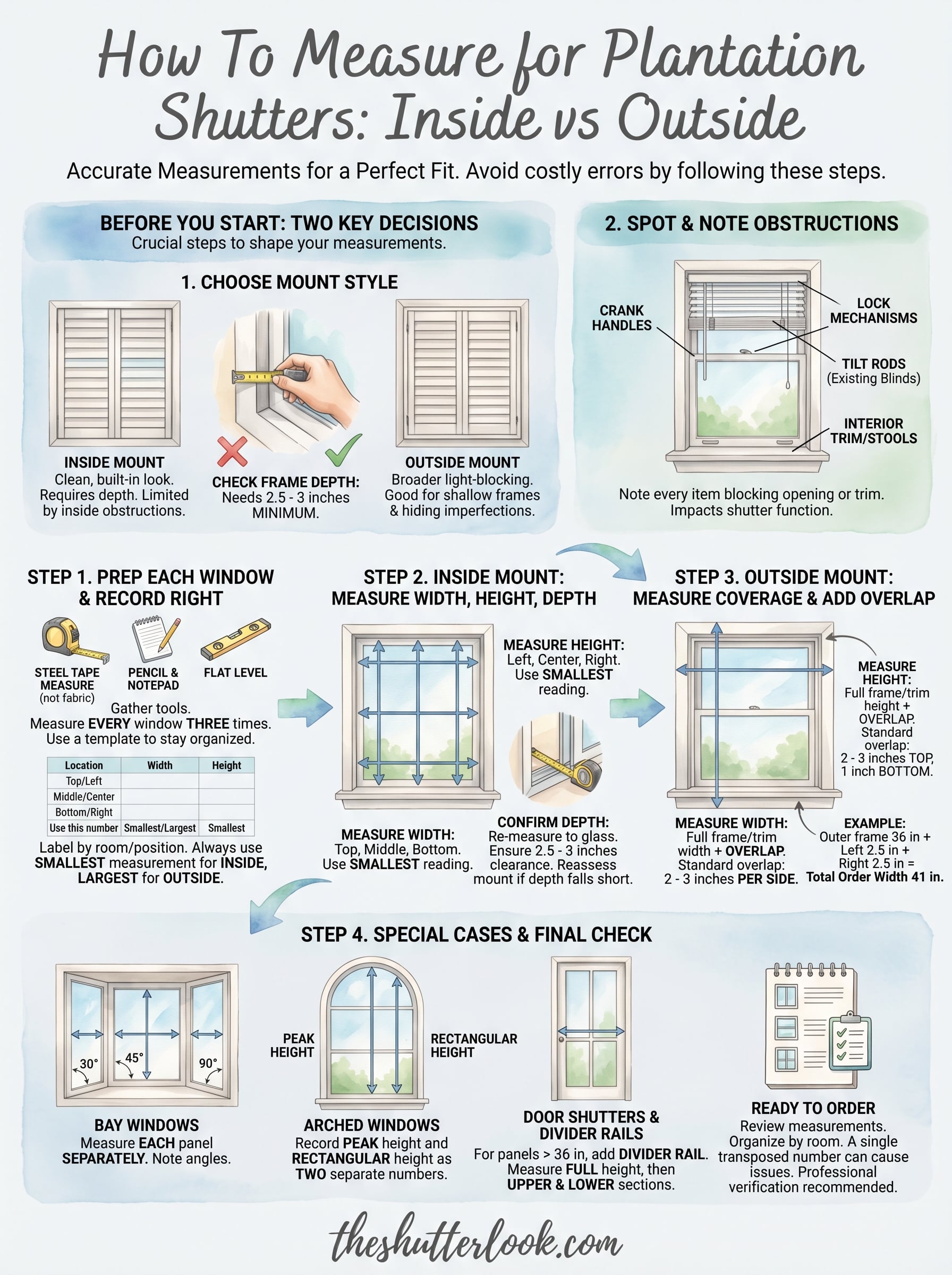
If you’re leaning toward an inside mount, frame depth is a hard requirement, not a rough guideline. Most plantation shutters need a minimum of 2.5 to 3 inches of depth inside the frame so the panels can open and close without hitting window cranks, handles, or the glass itself.
| Frame depth | Inside mount possible? |
|---|---|
| Less than 2.5 inches | No – use outside mount |
| 2.5 to 3 inches | Possibly, check for obstructions |
| 3 inches or more | Yes, inside mount works |
To check, press your tape measure straight back from the front edge of the frame to the glass or screen. If you land below the minimum, outside mount is your only realistic path forward.
Spot and note any obstructions
Window cranks, lock mechanisms, and tilt rods all affect whether shutters will open freely after installation. Walk each window and physically check what sits inside the frame opening or on the surrounding trim before you record a single number. Write down every obstruction so you can reference that list when reviewing your measurements or discussing the project with an installer.
Common items to check for include:
- Crank handles or levers on casement windows
- Lock mechanisms that protrude from the sill or side jamb
- Tilt rods on existing blinds if you’re replacing them
- Interior trim or window stools that narrow the usable opening
Step 1. Prep each window and record measurements right
Before you measure a single window, spend five minutes pulling together the right tools and setting up a clean recording system. Rushing this step is how homeowners end up with mismatched numbers across multiple windows. Good preparation directly reduces the chance of a measurement error that forces a reorder.
Gather the right tools
You need a steel tape measure, not a fabric or cloth one. Fabric tapes stretch over time and introduce small but meaningful errors. A steel tape that locks in place lets you pull it across the full width or height of a window opening without sag. Bring a pencil and a dedicated notepad, or use a notes app on your phone with a separate entry for each window. A flat level is also helpful for checking whether your sill is truly horizontal before you trust any single measurement.
Measure every window three times
The standard rule when figuring out how to measure for plantation shutters is to take each measurement three times and record all three numbers. Measure width at the top, middle, and bottom of the opening. Measure height on the left side, center, and right side. Windows are rarely perfectly square, so the three readings will often vary slightly.
Always use the smallest measurement when ordering inside mount shutters, and the largest when calculating coverage for outside mount shutters.
Use this simple template for each window:
| Location | Width | Height |
|---|---|---|
| Top / Left | ||
| Middle / Center | ||
| Bottom / Right | ||
| Use this number | Smallest | Smallest |
Label each window by room and position, for example "Living Room – Left Window," so your notes stay organized as you move through the house.
Step 2. Inside mount: measure width, height, depth
For an inside mount, you’re measuring the exact opening of the window frame, not the surrounding wall or trim. This is the most precise part of learning how to measure for plantation shutters, because even a small error here means the panel won’t fit. Place your steel tape from one side jamb to the opposite side jamb, capturing the true usable space the shutter needs.
Every number you record for an inside mount comes from inside the frame opening itself, never from the surrounding wall or trim.
Measure the width
Pull your tape measure horizontally across the opening at three points: near the top, at the midpoint, and near the bottom. Record all three numbers and use the smallest reading as your final width to ensure the panel fits without binding.
| Point | Width reading |
|---|---|
| Top | _____ in |
| Middle | _____ in |
| Bottom | _____ in |
| Order using | Smallest |
Measure the height
Measure vertically from the top of the opening to the sill at three points: the left side, the center, and the right side. Window openings are rarely perfectly square, so readings will often differ slightly. Use the smallest of the three as your working height.
If your sill has a noticeable slope, check whether the manufacturer offers custom height adjustments before placing your order.
Confirm the depth
Re-measure the frame depth by pressing your tape from the front edge of the frame straight back to the glass. Confirm it still clears the minimum the shutter model requires, typically 2.5 to 3 inches, before you submit your order.
If you find depth has fallen short because of a crank or handle, stop and reassess your mount style before ordering. A tight depth clearance is one of the most common reasons inside mount shutters end up not functioning correctly after installation.
Step 3. Outside mount: measure coverage and add overlap
For an outside mount, you’re measuring beyond the window opening, not inside it. The goal is to determine how much wall or trim space you want the shutter to cover, which means your starting point is the outer edges of the window frame or trim, not the jambs. This approach gives you control over both light blockage and the visual weight of the shutter on your wall.
Adding overlap on all sides is what separates a well-fitted outside mount shutter from one that lets light leak around the edges.
Measure the width and set your overlap
Start by measuring the full width of the window frame or trim from outside edge to outside edge. Then add your overlap to each side. A standard overlap is 2 to 3 inches per side, which blocks light effectively and gives the shutter a proportionate look on the wall. Your final width number is the frame width plus both side overlaps combined.
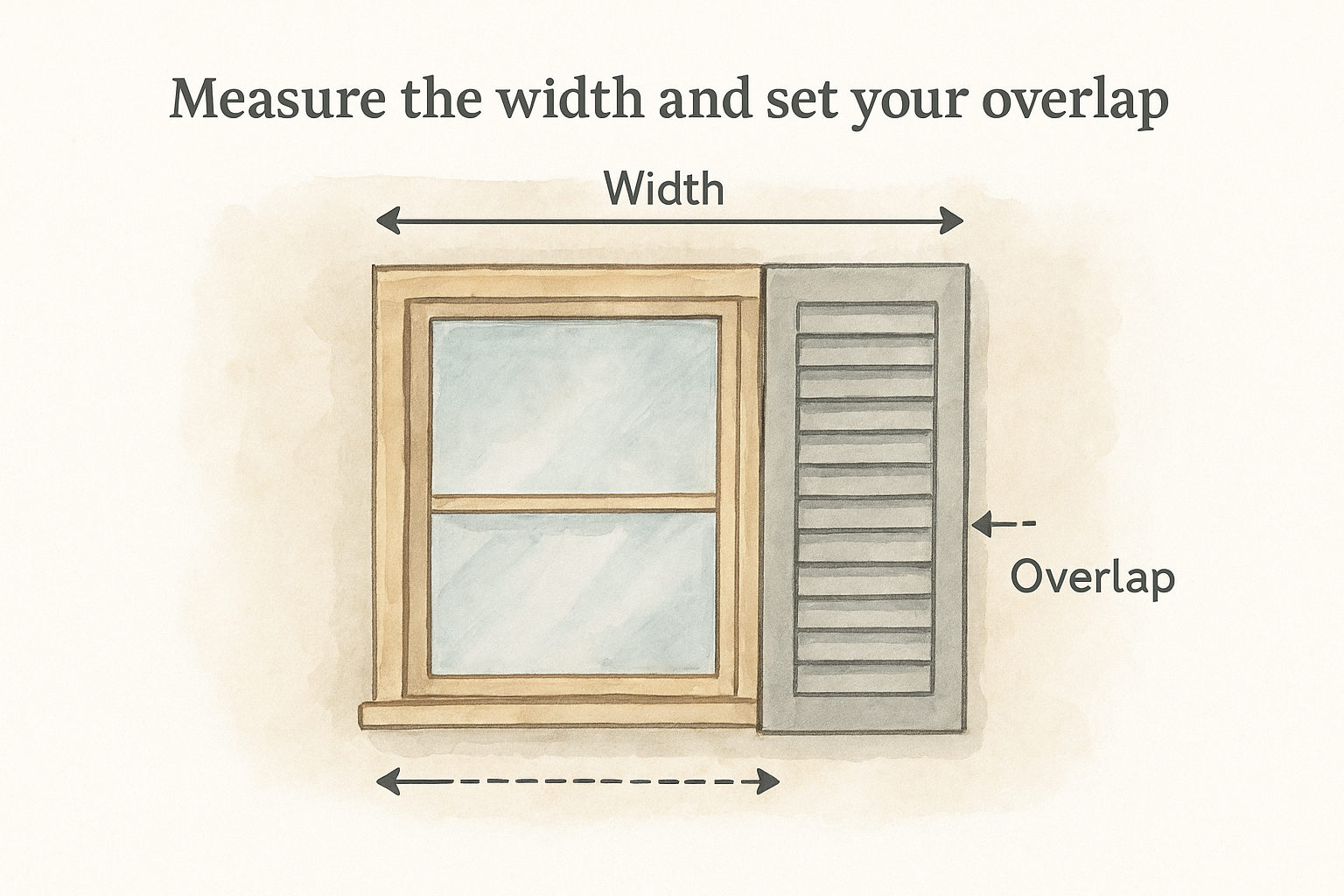
| Measurement | Example |
|---|---|
| Outer frame width | 36 in |
| Left overlap | + 2.5 in |
| Right overlap | + 2.5 in |
| Total order width | 41 in |
Measure the height and add top and bottom coverage
Measure from the top of the frame or trim to the bottom, then add overlap above and below. Most installations use 2 to 3 inches of overlap at the top and at least 1 inch at the bottom, though you can increase this if your window sits near an uneven sill. When working out how to measure for plantation shutters with an outside mount, always confirm your total height clears any baseboards or protruding hardware before finalizing your number.
Step 4. Bays, arches, doors, and divider rails
Some windows don’t fit a flat rectangular frame, and that changes how you approach measuring for plantation shutters entirely. Bay windows, arched frames, and door-mounted shutters each follow different measurement rules, and tall panels add the extra variable of divider rails. Treating these like standard openings almost always produces a poor fit.
Bay windows
Each section of a bay window is a separate, independent measurement. Measure the width and height of every panel individually and note the angle where the panels meet the wall, which is typically 30, 45, or 90 degrees. Record everything in a labeled sketch before you start ordering.
- Width at top, middle, and bottom for each panel
- Height at left, center, and right for each panel
- Wall angle at every connecting point
Arched windows
Arched windows require two separate height measurements: the full height from the sill to the peak of the arch and the height of the rectangular section below it. The difference between those two numbers gives your manufacturer the arch insert height needed to build a matching curved panel. Also record the width at the widest horizontal point of the opening.
Recording arch height and rectangular height as two distinct numbers is what allows the manufacturer to build the insert correctly.
Door shutters and divider rails
Tall openings and door-mounted shutters typically need a divider rail when the panel height exceeds 36 inches. Measure the full opening height, then choose a divider rail position at a natural sightline or midpoint. Record both section heights as separate numbers.
| Section | Measurement |
|---|---|
| Total height | _____ in |
| Upper section height | _____ in |
| Lower section height | _____ in |
| Divider rail position | _____ in from top |
You are ready to order
You now have everything you need to complete how to measure for plantation shutters accurately. Whether you chose an inside mount or an outside mount, recorded three readings per window, handled a bay, arch, or door panel, or noted where a divider rail belongs, your measurements are ready to use.
Keep your notes organized by room and window position before you submit anything to a manufacturer. A single transposed number can turn a correct measurement into a wrong order, so review each entry one more time before you finalize.
If you want a professional to verify your numbers or handle every step from measurement to installation, schedule a free in-home estimate with The Shutter Look. With over 23 years of experience fitting shutters across Central Florida, our owner measures every window personally and makes sure your shutters fit right the first time.
